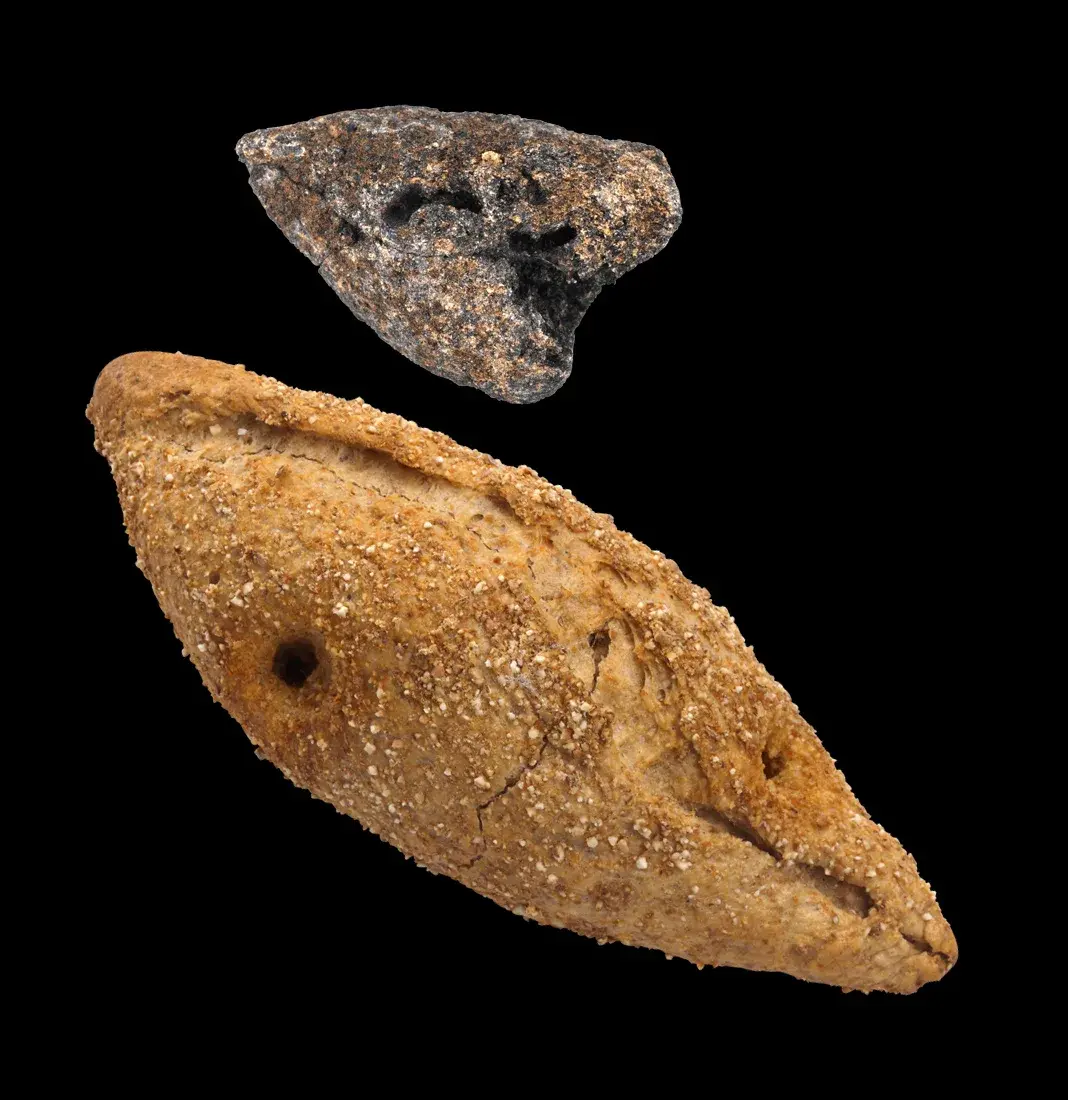
Ovelgönne Bread Roll
Spitzweck von Ovelgönne
Nordic Bronze Age / Early Iron Age (Northern Germany)
Curator's note
The Spitzwecken von Ovelgönne (Ovelgönne Bread Roll) stands as an extraordinary artifact at the intersection of prehistoric culinary art and three-dimensional plastic sculpture. Originating from the Pre-Roman Iron Age (ca. 800–500 BCE), this carbonized 2.5-gram fragment is recognized as Europe's oldest surviving formed bakery product.
Form Factor and Plastic Aesthetics
Discovered in 1952 within an Iron Age pit in the Ovelgönne district of Buxtehude, Germany, the object displays a refined biconical, double-pointed form (Spitzweck).
The extant charred fragment measures 35.0 mm in length, 22.94 mm in width, and 11.44 mm in height. Experimental reconstructions indicate that the original, intact unbaked roll was approximately 70 mm long, 45.88 mm wide, and 22.48 mm thick. Two deliberate visual and functional modifications define its upper surface:
- Longitudinal Scoring (Längseinschnitt): A fine, slightly curved cut along the main axis allowed internal steam to vent during baking, preserving the symmetry of the form.
- Stippled Puncture (Einstippung): Pressed into the center at a 45-degree angle with a rounded tool, this 2 mm deep indentation represents the earliest prehistoric evidence of decorative bread stippling in Europe.
Material Craftsmanship and Rheology
From a material perspective, the roll reveals a level of cereal refining unprecedented for its era:
- Refined Flour Processing: Unlike the coarse, whole-grain flatbreads common to daily prehistoric diets, this piece was crafted from finely sifted wheat flour (Weizenmehl). Microscopic analysis showed remarkably low mineral abrasion from stone querns, indicating multi-stage grinding and bolting.
- Dough Formulation: The dough was not leavened through wild yeast or sourdough. Instead, it was tenderized through the deliberate addition of lipids and proteins (such as animal fats, butter, or egg whites) to achieve a delicate crumb texture.
- Thermal Exposure: Baked on a stone hearth floor under intense top-heat, the surface carbonized into a pearl-gray to slate-gray hue, which ultimately enabled its organic preservation across millennia.
Iconographic and Ritual Interpretation (Opfergabe)
Given the substantial labor required to produce bolted wheat flour and the inclusion of valuable fats, scholars generally view the Ovelgönne roll not as ordinary sustenance, but as a sacred votive offering (Opfergabe) or ritual item.
Fine sand deposits found inside the fracture plane confirm that the roll was deliberately broken in half prior to its deposition into the pit a practice consistent with prehistoric votive rites where sacred objects were ritually severed before dedication. Radiological scans performed in Bern, Switzerland, also revealed two mysterious metallic particles embedded deep within the dough.
Today, the original charred artifact and a modern unburnt reconstruction are permanently exhibited at the Archaeological Museum Hamburg (Harburg), while contemporary artisan bakeries in Buxtehude continue to bake modern yeast-leavened adaptations of the traditional Spitzwecke