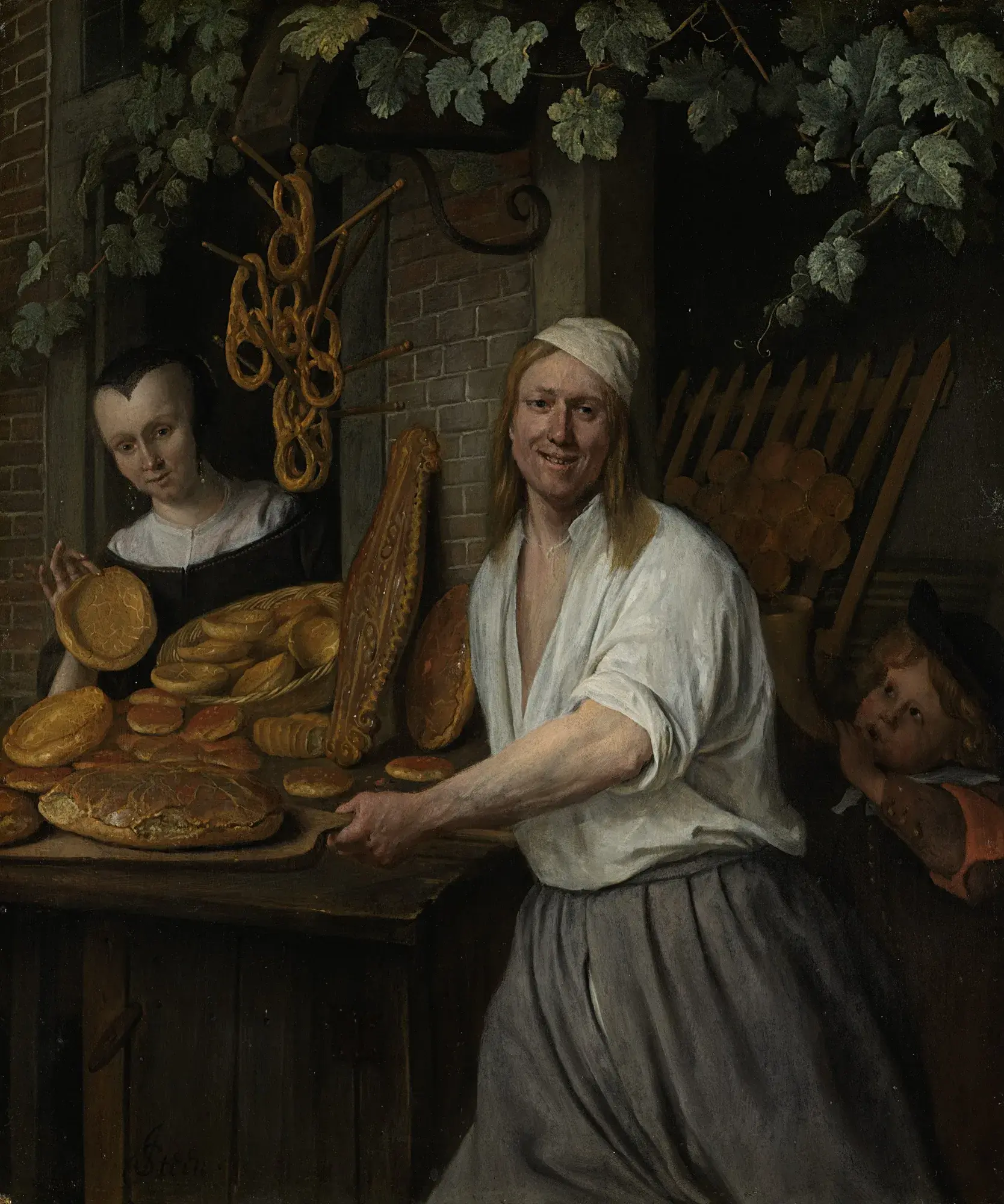
The Baker Arent Oostwaard and his Wife, Catharina Keizerswaard
Bakker Arent Oostwaard en zijn vrouw Catharina Keizerswaard
Jan Steen
Curator's note
Jan Havicksz Steen’s masterpiece, "Leiden Baker Arend Oostwaard and His Wife Catharina Keizerswaard" (c. 1658), expands far beyond the texture of a freshly baked loaf into the global colonial networks reaching across the Atlantic and Indian Oceans. The handwritten inscription from 1738 on the reverse transforms the canvas from a mere genre painting into a memory capsule of a baker’s family near Leiden’s Vrouwebrugge bridge.
Examining the rolls in the foreground, the hanging pretzels, and the delicate scoring on the loaves reveals how bread transcends its objecthood to become a symbol of civilization, social stratification, and colonial power structures.
What Does Bread Mean?
As Linda Civitello emphasizes, bread is "the first fully synthetic food, non-existent in nature, with every stage of its creation controlled by human intellect and labor." It marks the boundary line from nature to culture—the genesis of civilization.
- The Sacred Trinity: The Mediterranean trilogy of olive oil, wine, and bread revered in ancient polytheistic rituals and continuing into the Christian Eucharist elevated bread from basic sustenance to an existential symbol.
- The Benchmark of Civilization: The notion that "you might be a barbarian if you have never eaten bread" frames grain cultivation, milling, yeast fermentation, and baking as proof of humanity's emergence from savagery.
The Emergence of Dutch Bread Culture & Social Class Symbolism
While the exact era when bread became the primary Dutch staple remains uncertain (despite grain traces in Zuid-Limburg dating to 4500 B.C.), bread served as the clearest visual indicator of social hierarchy during the Dutch Golden Age (17th century).
| Bread Type | Consumer Group | Sociological & Cultural Significance |
|---|---|---|
| Dark Rye & Coarse Wheat | Lower classes, orphans, laborers | Deep-seated physiological affinity paired with budgetary necessity; the daily caloric base of the common populace. |
| White Bread (Wheaten) | Nobility, wealthy merchants, urban elites | A signifier of affluence, prestige, and urban superiority; an aspirational staple for the lower classes. |
| Adorned / Luxury Bakes | Elite consumption | Ornamental loaves banned from window displays by the 1601 ordinance to prevent envy among the poor. |
The social scope of bread extended to government intervention and civic guilds:
1. Bread as Social Welfare: Between 1656 and 1658, the Amsterdam municipality distributed wheat bread to the poor at fixed prices (14 stuivers for an 8-pound loaf), using bread as a direct instrument of social aid. 2. Price & Weight Regulation (Zetting & Rijding): Municipal authorities set prices rather than bakers to safeguard against famine and civil unrest. For rye bread (zetting), the weight was kept constant while prices fluctuated with grain markets. For white bread (rijding), the price remained fixed while the loaf weight varied. Official notices were posted on church doors. 3. Bakers' Guilds: Guilds maintained market shares and strictly regulated trade. Becoming a master baker required citizenship, years of apprenticeship as a journeyman, and passing a master exam. Guilds operated tight-knit networks, minting their own coins and organizing colleague funerary rites.
From Raw Ingredient to Global Power: Grain, Salt, and Dutch Wealth
The flour inside Steen’s bakery did not originate solely from Dutch soil. The two foundational components of bread—grain and salt—tell the narrative of Dutch commercial expansion:
- The Baltic Trade (Moedernegotie): By the mid-17th century, roughly 120,000 tons of grain entered Amsterdam annually. The Amsterdam grain exchange dictated pricing across all secondary European markets.
- Regional Agricultural Roles: Drenthe, Gelderland, and Limburg cultivated moisture-thrifty rye, whereas Zeeland produced high-grade wheat. Local yields were insufficient, making Baltic imports necessary to feed the populace and supply re-exports to France, Spain, and Portugal.
- Salt and Colonization: Salt—essential for dough structure—drove the Dutch conquest of Caribbean islands like Curaçao and Bonaire to secure reliable salt pans.
Dutch Bread in the Colonies: Cultural Exchange and Global Trade
As Dutch maritime networks expanded, bread transformed in both material composition and symbolic meaning across overseas territories.
1. New Netherland (North America)
- Indigenous Trade: European white bread and sweet baked goods (cookies) became highly prized trade items for Native Americans, whose traditional staple was boiled cornmeal.
- Trade Regulations: Bakers prioritized lucrative sales to Native Americans over supplying local settlers, prompting a 1649 law banning commercial baking dedicated strictly to indigenous trade.
- Linguistic Legacy: The New Year’s festive delicacy nieuwjaarskoeken integrated into early American baking, introducing the word "cookie" into the English language (distinct from the British usage of "biscuit").
2. The Dutch East Indies (Indonesia)
- Urban Luxury & Prestige: In tropical Asia, European bread functioned as a luxury symbol of an urban elite lifestyle. Historical establishments like Maison Bogerijen (Bandung) and Toko Oen (Semarang) catered to Dutch colonials and affluent local elites.
- Linguistic Adaptation: The Sanskrit-derived word roti (originally referring to flat unleavened bread) became the generic Malay term for all European leavened breads (brood) in 19th-century cookbooks such as Kokki Bitja (1859).
- Theological Cuisinature: Introduced alongside Protestant mission societies (NZG) and Western educational institutions, bread consumption was adopted by the Christianized indigenous elite as a tangible display of Westernization and social status.
Jan Steen’s depicted loaves represent far more than oil paints on canvas; they embody a global history connecting 17th-century Amsterdam bread lines, Baltic maritime grain routes, Native American trade, and colonial dining rooms in Java.