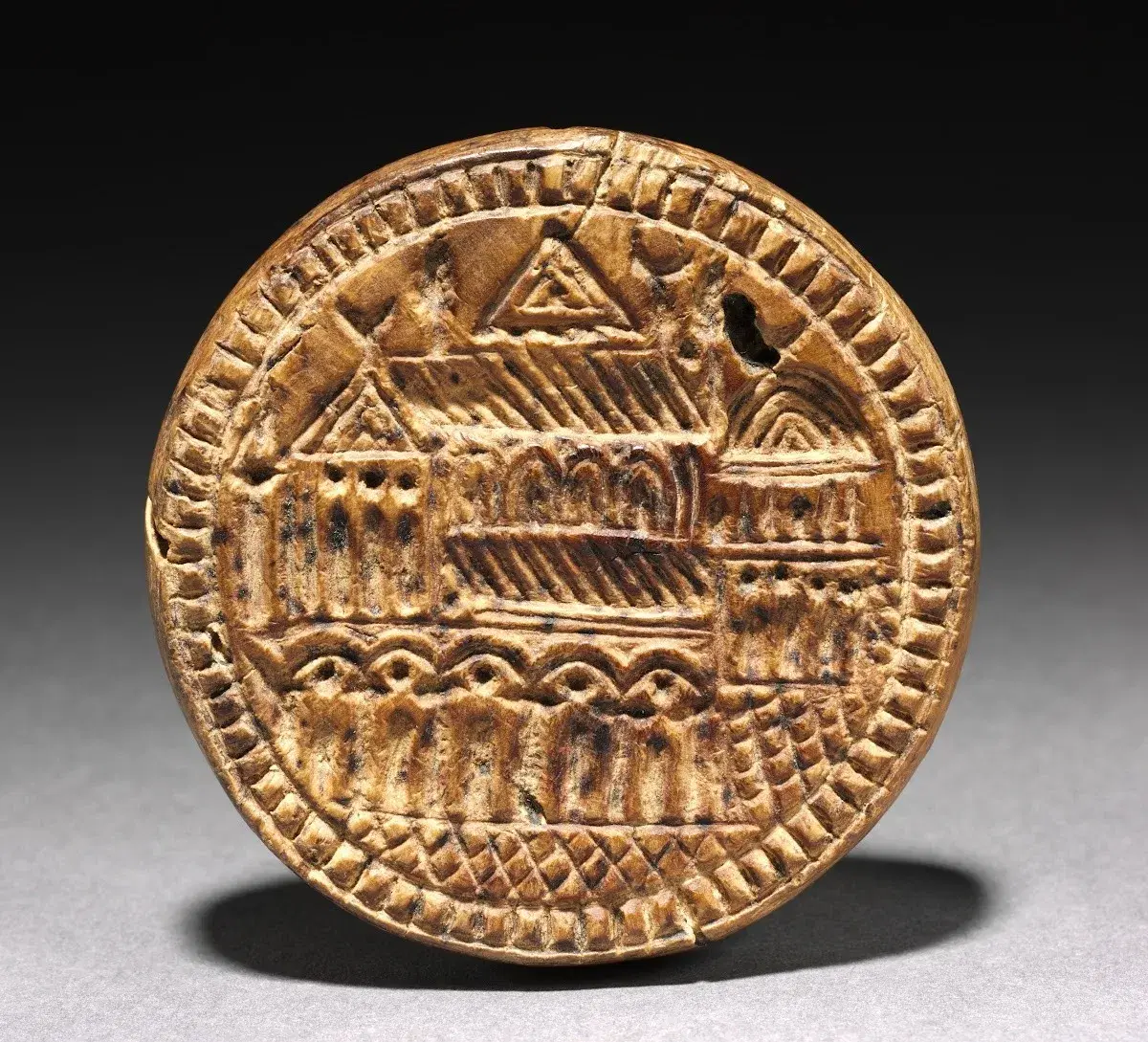
Mold for a Eulogia (Blessing) Bread
Mold for a Eulogia (Blessing) Bread
Byzantine, Palestine
Curator's note
When examining art historical artifacts, scholars and enthusiasts often gravitate toward monumental marble sculptures, gilded mosaics, or imposing architectural structures. Yet, the objects that evoke a civilization's spiritual world, daily life, and human emotions most profoundly are sometimes small in scale and modest in material. The wooden Mold for a Eulogia (Blessing) Bread, dated to between the 7th and 10th centuries (Byzantine Period, Palestine) and displayed in the Cleveland Museum of Art (Gallery 105, Byzantine Art section), is precisely such an object.
A 1,000-Year History Carved in Wood: Technical Details
Cataloged in the museum inventory under accession number 1951.152 and acquired as a 35th Anniversary Gift of Mr. and Mrs. Paul Mallon, this artifact is classified under medieval Byzantine sculpture and decorative arts.
Measuring 8.8 cm in diameter and 1.9 cm in depth, this circular wooden mold features an exceptionally compact structure. Due to the organic nature of wood, its survival to the present day is a rare occurrence, rendering the artifact uniquely valuable for understanding Byzantine woodworking craftsmanship and everyday religious practices.
| |
Eulogia": Blessed Mementos Carried from the Holy Land
In Early Christian and Byzantine tradition, stamping sacred symbols and inscriptions onto bread dough prior to baking was a widespread practice. The primary function of this carved mold was to shape blessed loaves known as eulogia (blessings).
Medieval Christian pilgrims undertook arduous journeys lasting months or even years to visit sacred sites across the Holy Land. Upon returning to their homelands at the conclusion of these spiritual travels, pilgrims brought home physical souvenirs as tangible proof of their pilgrimage and the blessings they received. Among these sacred mementos (eulogia) were holy water flasks, saintly relics, and specially blessed loaves of bread.
As noted in museum records, this specific carved wooden stamp was utilized to imprint symbolic motifs directly onto blessed loaves of bread distributed to pilgrims visiting Jerusalem as sacred commemorations of their spiritual voyage.
Symbolic Depiction of Golgotha and the Church of the Holy Sepulcher
The carving on the mold serves more than a purely decorative purpose; it visually articulates one of the core sanctuaries of Christian iconography. The relief image depicts the Church of the Holy Sepulcher, constructed over Golgotha just outside the walls of Jerusalem, marking the traditional site of Christ's crucifixion and burial.
When stamped onto bread dough, the resulting raised image represented the sacred physical site where the pilgrim had personally stood and worshiped. Through this architectural imprint, an ephemeral and consumable object—bread—was transformed into a lasting symbol of faith, memory, and pilgrimage.
Conclusion: A Modest Witness Transcending Time
Exhibited within the Byzantine collection of the Cleveland Museum of Art, this carved wooden mold illuminates the human-scale dimension of popular devotion and medieval pilgrimage culture beyond imperial grandiosity. Spanning less than nine centimeters in diameter, this small wooden object continues to carry forward the faith, journeys, and memories of thousands of pilgrims who reached Jerusalem between the 7th and 10th centuries.