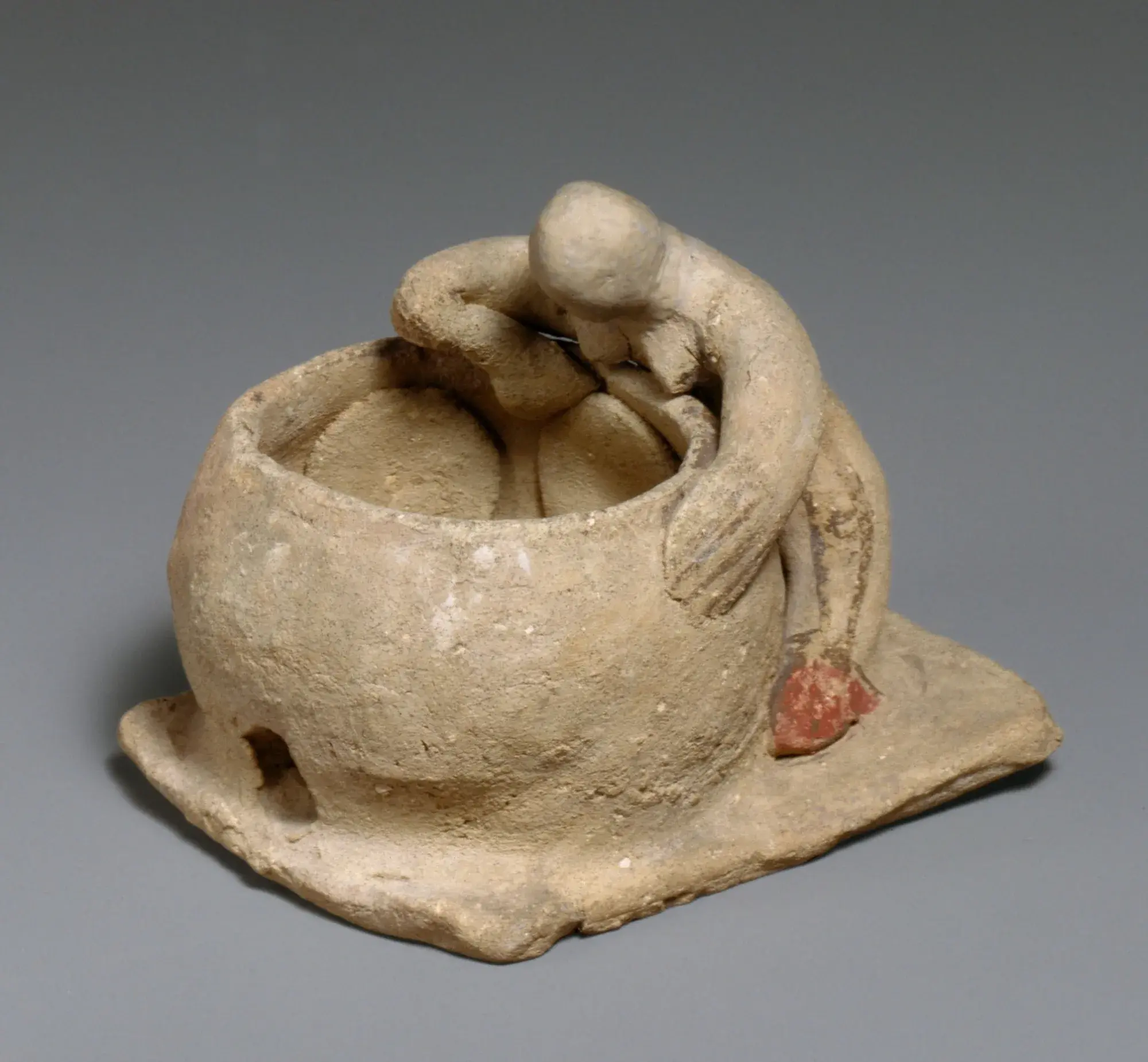
Terracotta Woman Baking Bread
Terracotta Woman Baking Bread
Cyprus
Curator's note
Archaeology sometimes speaks most eloquently not through monumental temples or royal tombs, but through a humble clay figurine small enough to fit in the palm of your hand—a tiny object that freezes everyday human life across millennia. Dating back roughly 2,600 years to the Eastern Mediterranean island of Cyprus, this terracotta figurine captures the vivid moment of a woman slapping flatbread dough onto the hot interior wall of a tandoor oven.
Housed today in the Cesnola Collection at The Metropolitan Museum of Art (The Met) in New York, this artifact stands as one of the most tangible pieces of evidence showing just how ancient, enduring, and universal traditional baking technology truly is.
Despite standing barely three inches tall, the ancient artisan captured the physical mechanics and sensory reality of breadmaking with remarkable observational skill:
- The Tandoor Oven and Ventilation Opening: The cylindrical clay structure in front of the woman, tapering slightly toward its open mouth, represents the classic tandoor (tabun / tannur) oven used across the Near East and Eastern Mediterranean for thousands of years. The small arched opening near the bottom left of the oven served as a draft and ash hole—allowing air circulation to feed the fire while enabling the baker to stoke wood or dung fuel inside.
- Flatbreads Slapped onto the Interior Wall: Looking closely inside the oven's rim, two round, flattened discs of dough can be clearly seen pressed against the heated inner wall. This detail directly documents the ancient technique of baking unleavened or lightly fermented flatbreads made from wheat and barley flour.
- Body Language and Shielding from Heat: The female figure grips the outer rim of the oven firmly with her left hand for leverage while reaching deep inside with her right arm to press the dough onto the scorching surface. The subtle tilt of her head and torso away from the mouth of the oven reflects a natural human reflex to shield her face from rising heat and smoke.
- Surviving Paint Traces: Distinct reddish and dark pigment remnants visible along her leg and footindicate that the figurine was originally painted in vibrant colors in antiquity.
Significance in Archaeobotany and Ancient Baking History
The history of bread extends far beyond recipes—it is a long technological evolution spanning grain domestication, milling tools, and kiln architecture:
- Continuity of Tandoor Technology: Tandoor ovens trap intense thermal energy within thick clay walls, baking dough within seconds or a few minutes through both direct conduction (contact with the clay) and convection (circulating hot air). The cylindrical tandoor form used in 6th-century BCE Cyprus survives virtually unchanged today in rural kitchens stretching from Anatolia to Central Asia, the Levant, and North Africa.
- Ancient Grains and Dough Structure: In 1st-millennium BCE Cyprus and the broader Eastern Mediterranean, the primary bread cereals were Emmer wheat (Triticum dicoccum), Einkorn (Triticum monococcum), early bread wheat (Triticum aestivum), and barley. Ground on stone saddle querns or early rotary mills, these flours contained high bran content and possessed low-to-moderate gluten strength. Rather than rising into tall, airy loaves, shaping the dough into thin, pliable flatbreads (resembling lavash or pita) and adhering them directly to the oven wall was the most efficient baking method.
- Why Was It Made? Votive Offering or Grave Good? During the Cypro-Archaic period, small terracotta figurines depicting scenes of daily labor—bakers, dough kneaders, musicians, and potters—were typically created for two primary purposes:
- Funerary Offerings (Grave Goods): Placed inside tombs so the deceased would remain nourished and enjoy the comforts and abundance of household life in the afterlife.
- Sanctuary Votives: Dedicated at temples to express gratitude or pray for fertility, agricultural abundance, and domestic prosperity—often associated with the Great Goddess of Cyprus (later identified with Aphrodite).