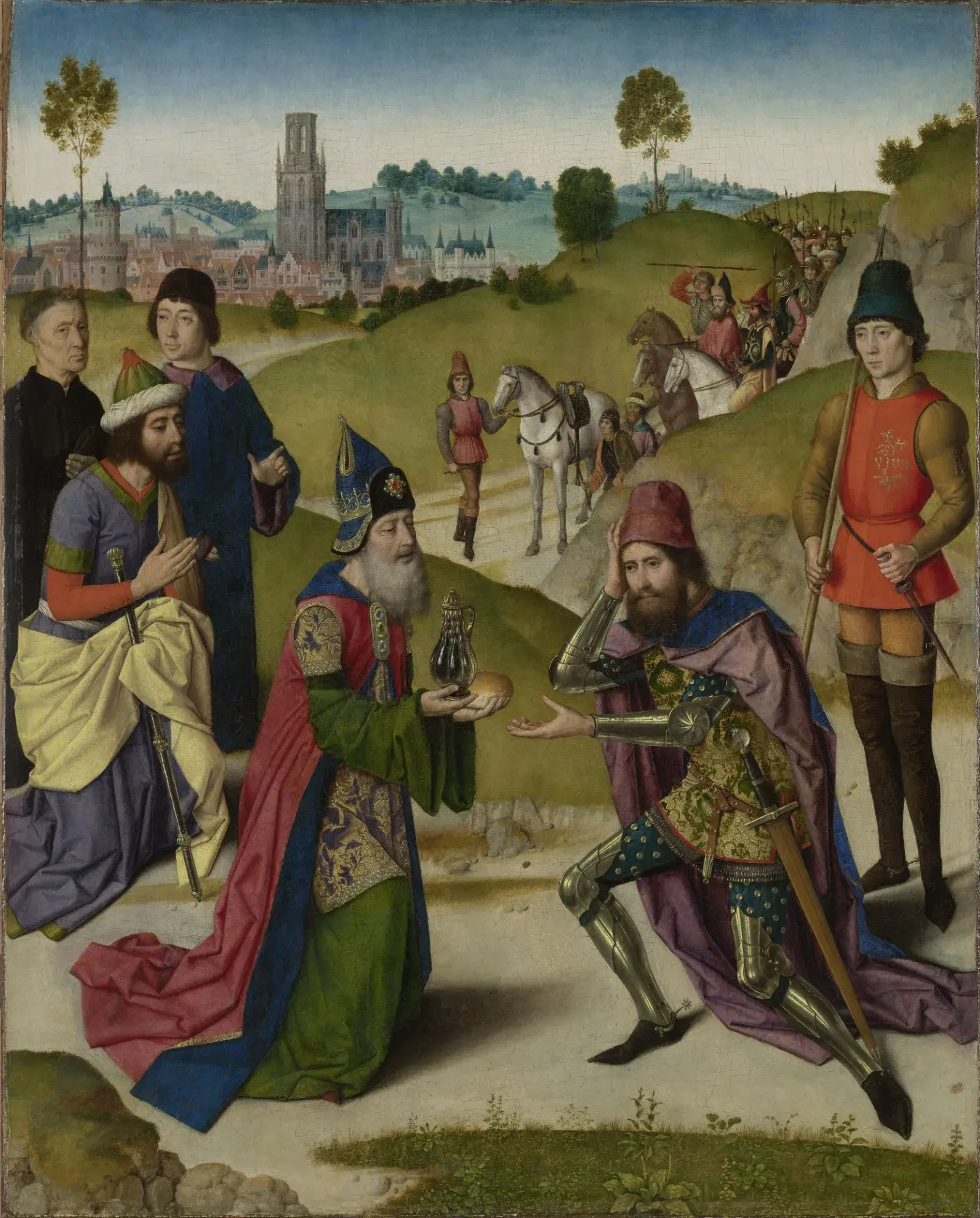
The Meeting of Abraham and Melchizedek
Melchisedek Offering Bread and Wine to Abraham
Dieric Bouts
Curator's note
Among the serene masterpieces of early Netherlandish panel painting, Dieric Bouts’s The Meeting of Abraham and Melchizedek stands out as a monument of quiet theological intensity. Originally executed between 1464 and 1468 as a side wing for the grand Altarpiece of the Holy Sacrament in St. Peter's Church (Sint-Pieterskerk), Leuven, this composition captures an encounter that appears at first glance to be an open-air military greeting. Yet at the precise geometric and devotional core of the panel rests a single, humble, yet profoundly divine object: a modest loaf of rustic bread held in the hands of King Melchizedek.
Through a masterful synthesis of outdoor linear perspective, typological symbolism, and Northern European naturalism, Bouts elevated this simple loaf into the absolute pivot of space, time, and liturgy.
From Genesis to the Altar: Typological Prefiguration of the Eucharist
The narrative source for this panel is rooted in the Old Testament book of Genesis (Genesis 14:17–20). Returning victorious from his campaign against King Chedorlaomer, Abraham enters the Valley of Shaveh, where he is met by Melchizedek, the King of Salem and "Priest of God Most High." Melchizedek offers bread and wine to refresh Abraham and his weary soldiers, bestowing a sacred blessing upon the patriarch.
In Medieval and Early Renaissance theology—codified in widespread typological handbooks such as the Biblia Pauperum and Speculum Humanae Salvationis—this Old Testament narrative was interpreted as the primary biblical prefiguration (antitype) of Christ’s Last Supper and the Sacrament of the Eucharist.
| Testament & Epoch | Historical Actor | Sacred Action & Medium | Theological Significance |
|---|---|---|---|
| Old Testament (Prototypical) | Melchizedek (King of Salem & Priest) | Offering of Bread and Wine to Abraham | Physical refreshment after battle; Old Covenant prefiguration of the Holy Communion |
| New Testament (Fulfillment) | Jesus Christ | Blessing and Distribution of the Host | Transubstantiatio: The literal transformation of bread into the Body of Christ |
| 15th-Century Leuven (Liturgical Continuity) | Confraternity of the Holy Sacrament | Eucharistic Liturgy & Altarpiece Devotion | Devotio Moderna: Individual and communal salvation through intimate contemplation |
By presenting Melchizedek in the liturgical vestments of a medieval bishop offering a raised loaf, Bouts directly bridges this Old Testament encounter to Christ’s institution of the Holy Communion ("This is my body") depicted in the altarpiece's central panel. The bread serves as the tangible link in an unbroken divine covenant spanning centuries.
Geometrical Precision: Linear Perspective and the Focal V-Axis
Dieric Bouts holds a distinguished position in Northern Renaissance art history as one of the earliest Flemish masters to apply rigorous Italianate linear perspective to an open-air landscape. In The Meeting of Abraham and Melchizedek, every spatial line and compositional vector converges to draw the viewer’s gaze directly toward the loaf of bread.
"The spatial architecture of Bouts’s panel is constructed around a deliberate optical trap: while the eye is initially drawn to the gleaming steel armor and rich brocades, the entire compositional geometry locks irreversibly onto the matte brown surface of the consecrated loaf."
Bouts achieves this visual dominance through three distinct pictorial strategies:
- The Diagonals of the V-Axis: On the left, Abraham kneels in polished 15th-century Burgundian steel armor, his body leaning forward in reverence. On the right, Melchizedek stands in heavy golden brocade and velvet vestments. The converging contours of these two powerful figures form a sharp V-shaped diagonal axis. The precise intersection point where these two masses meet and lock is the extended loaf of bread.
- Tactile and Chromatic Contrast: Bouts juxtaposes the cold, reflective metallic highlights of Abraham’s steel boots and pauldrons against the warm, heavy texture of Melchizedek’s gold-embroidered cloak. Nestled between these opulent surfaces, the bread is painted in a subdued, naturalistic matte brown tone. Through delicate impasto and fine brushwork, Bouts renders the crisp texture, weight, and crust of handcrafted Flemish bread.
- Hierarchical Elevation: While a servant behind Melchizedek holds a silver wine flagon in the middle ground, the bread is held prominently in the foreground, raised precisely to eye level to command immediate devotional reverence.
15th-Century Leuven and Devotio Moderna: Theologians at the Scene
The precise contract for the Altarpiece of the Holy Sacrament was formally signed on March 15, 1464, between Dieric Bouts and the four guardians of the Confraternity of the Holy Sacrament in Leuven. A remarkable stipulation in the contract required Bouts to execute the work entirely with his own hand and under the strict theological guidance of two professors from the University of Leuven's Faculty of Theology: Johannes Varenacker and Egidius Bailuwel.
This theological oversight coincided with the peak influence of the Devotio Moderna (Modern Devotion) movement across Flanders. Embracing personal piety, interior meditation, and a direct spiritual connection to Christ, Devotio Moderna reframed the Eucharistic bread as an accessible portal to personal redemption rather than an abstract ecclesiastical privilege.
Under the professors' instruction, Bouts populated the background of the ancient Valley of Shaveh with 15th-century Leuven burghers and theologians dressed in contemporary Flemish attire. By collapsing biblical history with 15th-century reality, Bouts transformed the ancient offering into an active, contemporary liturgy: the bread extended by Melchizedek becomes the very Host presented to the Leuven faithful kneeling before the altar.
A Restitution Odyssey: From Versailles to the Salt Mines
As a cornerstone of Northern European Eucharistic art, this panel has experienced a turbulent geopolitical history, reflecting centuries of European conflict and art restitution:
- Dismantling (1707): The triptych was separated; while the central Last Supper panel remained at St. Peter's Church in Leuven, the side wings were removed and dispersed.
- Prussian Acquisition (1834): The Meeting of Abraham and Melchizedek panel was acquired by the Berlin Gemäldegalerie.
- The Treaty of Versailles (1919): Following World War I, Article 247 of the Treaty of Versailles specifically stipulated that Germany must return the dispersed side panels to Belgium to reunite Bouts's original triptych in Leuven.
- WWII Seizure and Recovery (1942–1945): During the Nazi occupation, the altarpiece was confiscated and hidden deep inside the Altaussee salt mines in Austria. It was rescued in 1945 by the Allied "Monuments Men" unit and permanently restored to Sint-Pieterskerk.d
Often hailed by art historians as the "Painter of Silence," Dieric Bouts imbued The Meeting of Abraham and Melchizedek with a profound, motionless dignity. By stripping the figures of exaggerated theatrical drama and bathing the Flemish landscape in clear, crystalline light, Bouts creates a meditative sanctuary around the central motif.