The Gleaners
Des Glaneuses
Jean-Francois Millet
Curator's note
Bread, humanity’s most foundational and sacred nourishment, is far more than a biochemical matrix of flour, water, and yeast. It stands as the ancient symbol of sweat poured into the soil, seasonal cycles, struggles for social justice, and the unyielding human drive for survival. From the perspective of baking and cereal science, the quality and nutritional value of a single loaf depend directly on a timely field harvest and the precise balance between starch and protein within the wheat grain (
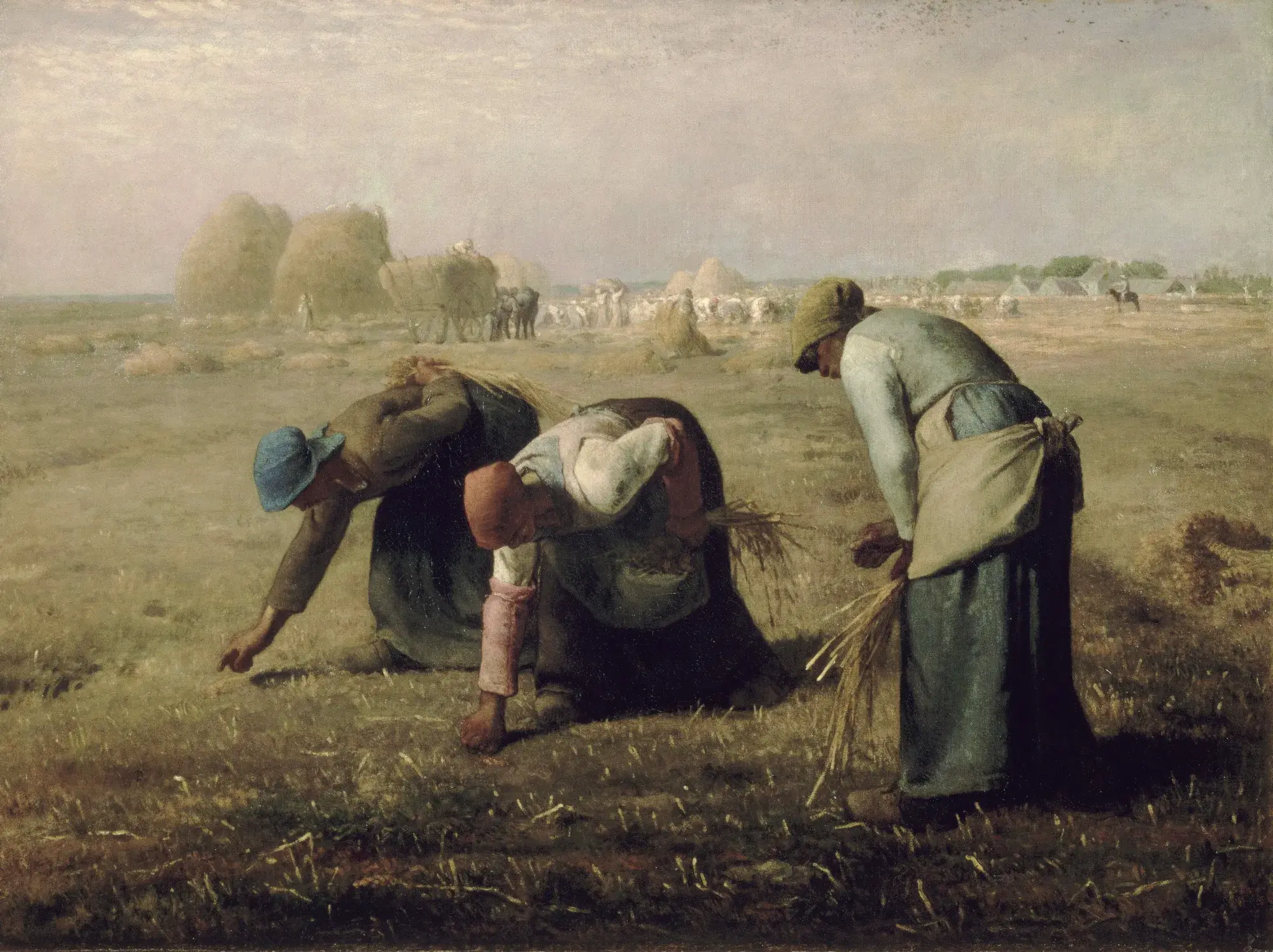
From the standpoint of art history, however, bread transforms into an aesthetic and socio-political manifesto—most strikingly embodied in Jean-François Millet’s monumental 1857 masterpiece, Des Glaneuses (The Gleaners)—proclaiming the human dignity and systemic class contradictions of society’s most marginalized workers.
Housed in the permanent collection of the Musée d'Orsay in Paris (Inventory No: RF 592), this 83.8 cm × 111.8 cm oil on canvas depicts three peasant women gathering leftover stalks of wheat after the main harvest has been completed. Combining the analytical eye of an art historian with that of a cereal scientist, this study provides an in-depth examination of the aesthetic, socio-political, and nutritional context of the wheat grains rendered by Millet's brush.
The Tradition of Gleaning and the Sociology of Cereal Grains
In 19th-century France, "gleaning" (le glanage) was an ancient legal and customary survival mechanism relied upon by landless rural populations to combat famine before the onset of modern industrialized agriculture. With historical roots extending back to biblical ordinances in Leviticus and the Book of Ruth, this tradition permitted impoverished women, children, and orphans to enter the fields at dusk after landowners had gathered the primary harvest, allowing them to scavenge scattered stalks lying on the stubble. Although codified as a communal welfare right, gleaning faced increasing restriction by large landowners during the mid-19th century due to the enclosure of common lands, commercialization of farming, and the expansion of large agricultural estates in France. Millet captures the dramatic reality of this critical historical turning point. The solitary wheat grains forgotten in the fields were the sole refuge standing between a peasant family and destitution on the long path toward a warm loaf of oven-baked bread.
Anatomy of the Canvas: Three Bodies, Circular Rhythm of Labor, and Spatial Hierarchy
As a co-founder of the Barbizon School who advocated working directly from nature (en plein air), Millet elevates a routine agricultural task beyond a static snapshot into a continuous choreography of physical labor. Positioned prominently in the foreground, three peasant women embody three distinct, sequential phases of the gleaning process:
1. The Woman on the Left: Bends her body at a steep angle toward the earth, her eyes intently scanning the ground for fallen stalks. 2. The Woman in the Center: Reaches downward to grasp a solitary ear of wheat, her calloused fingers clamping around the stem. 3. The Woman on the Right: Slenderly adjusts her posture, straightening slightly to deposit her meager bundle of collected stalks into her apron pouch.
This tripartite arrangement guides the viewer's eye from left to right and back again, rendering tangible the mechanical, backbreaking, and cyclical rhythm of physical toil that stretched from dawn to dusk. Their facial features are cast in shadow and stripped of individualized detail, emphasizing their collective, sculptural identity as representatives of the rural working class rather than specific biographical figures.
| Compositional Criterion | Foreground (The Gleaners) | Background (Landowner & Primary Harvest) |
|---|---|---|
| Action & Object | Collecting scattered, discarded wheat stalks | Massive haystacks, harvest wagons, immense abundance |
| Social Status | Landless, impoverished rural women | Wealthy estate owner, large workforce, mounted supervisor |
| Light & Color | Harsh, low sunset light; Blue, Red, Ochre/Brown | Hazy, dusty golden atmosphere (powdery golden haze) |
| Spatial Stance | Proximate to viewer, bent sculpted masses | Distant, grand scale of wealth and property ownership |
Plastically, a profound spatial and social divide exists between the sculptural weight of the women in the foreground and the bountiful agricultural wealth in the background. Rising in the distance, colossal stacks of wheat and loaded harvest carts represent tons of grain heading toward commercial mills and bakeries, while the women in the foreground can access only a few handfuls of stray wheat. On the far right background, a solitary figure mounted on horseback (the overseer) represents property boundaries, legal enforcement, and landlord control. The steep scale discrepancy between the elevated supervisor and the stooped bodies of the women serves as the primary visual tool depicting class hierarchy.
Furthermore, careful visual analysis reveals the deliberate color choices in the women’s garments: the blue bonnet of the woman on the left, the red sleeve ties of the center figure, and the muted white headscarf of the woman on the right subtly recall the French Tricolour, serving as a quiet nod to republican ideals of liberty, equality, and social justice.
The 1857 Paris Salon and Bread Anxiety: The Bourgeoisie’s Fear of Unrest
When The Gleaners was exhibited at the 1857 Paris Salon, it provoked a wave of anxiety among conservative critics and bourgeois gallery-goers. This reaction stemmed from both aesthetic nonconformity and immediate socio-economic fears.
In the aftermath of the 1848 Revolutions, poor harvests and rising bread prices frequently sparked rural unrest and urban riots across France. To the urban bourgeoisie, the agricultural worker harvesting wheat was perceived not merely as a peaceful laborer, but as a potential revolutionary threat—one who produced the nation's bread yet could ignite uprisings when deprived of a fair share. Conservative art critics openly expressed alarm, with one writing that he saw behind these three women "the shadow of the 1793 Jacobin guillotines and impending social upheaval."
Additionally, according to rigid academic painting hierarchies, canvases of such monumental scale (over one meter wide) were strictly reserved for classical mythology, biblical history, or heroic military victories. Millet’s decision to depict ordinary, impoverished peasants on a heroic scale was harshly condemned by critics such as Paul de Saint-Victor, who derided the figures as lacking aesthetic idealization and labeled them the "Three Fates of Poverty."
Biblical Hermeneutics and Comparison with the Book of Ruth
Millet’s upbringing in a devout Norman farming family deeply informed the spiritual and biblical undertones of his work. Between 1850 and 1853, Millet painted Harvesters Resting (Ruth and Boaz), depicting the Old Testament story from the Book of Ruth where the wealthy, benevolent landowner Boaz welcomes the vulnerable gleaner Ruth, illustrating divine mercy and patriarchal protection.
In The Gleaners of 1857, however, Millet strips away this reassuring, romanticized narrative of charity. There is no compassionate Boaz offering water or grain; in his place stands a distant, indifferent overseer atop a horse.
Millet translates the biblical decree of Genesis 3:19—_"By the sweat of your brow you will eat your bread"_—into a secular, realist framework. Bread is portrayed neither as a miraculous divine gift nor as a patronizing gesture of bourgeois charity, but as the hard-won product of arduous physical labor extracted directly from the soil.
Market Reception, Provenance, and Transformation into a National Icon
Deterred by the fierce public controversy, buyers initially shunned the painting, forcing the financially strained Millet to sell it in 1857 to an English collector named Binder for the modest sum of 3,000 francs. Following Millet's death in 1875 and the rise of the French Third Republic, public appreciation for the work shifted dramatically.
At an auction in 1889, the canvas fetched a record-breaking 300,000 francs. To prevent the masterpiece from leaving the country for an American private collection, Madame Jeanne-Alexandrine Louise Pommery, head of the famous champagne house, purchased the painting and bequeathed it to the French state for the Louvre. This patriotic act transformed The Gleaners from a politically subversive canvas into a cherished symbol of French national heritage. Since 1986, the painting has resided prominently in the Musée d'Orsay.
Legacy from Art History to Contemporary Culinary Culture
Jean-François Millet’s uncompromising realism inspired subsequent generations of artists, filmmakers, and modern food movements:
- Vincent van Gogh: Van Gogh harbored an intense admiration for Millet, copying his compositions to hone his own artistic voice. Van Gogh's early masterpiece The Potato Eaters (1885) and his extensive wheat field series draw directly upon Millet’s reverence for rural labor and essential staple foods.
- Agnès Varda and Modern "Gleaning": French New Wave director Agnès Varda used Millet's canvas as the conceptual foundation for her acclaimed 2000 documentary Les glaneurs et la glaneuse (The Gleaners and I), exploring contemporary urban scavengers, food waste, and agricultural produce left unharvested due to aesthetic market standards.
- Modern Bread and Zero-Waste Movements: In today's discussions surrounding food security, sourdough baking, and zero-waste culinary ethics, the concept of gleaning has experienced a major revival as a sustainable practice to salvage field crops and honor every kernel of grain.