Under the Shadow of the Red Miracle: Serratia Marcescens and Its Relationship with Bread
Introduction: The Phenomenon of Bleeding Bread
Throughout human history, bread has not only been a staple food, but also one of the most sacred symbols of life, abundance, and divine existence. However, from time to time, blood-red, viscous spots appearing on breads taken out of ovens or stored in temple cellars invoked deep fear and awe in the souls of the masses. From Antiquity to Medieval Europe, “bleeding bread” phenomena were interpreted as the wrath of the gods, harbingers of impending disasters, or direct manifestations of divine miracles. Yet behind this mystical picture lay not supernatural forces, but an invisible microscopic artist: Serratia marcescens.
1. The Birth of the Unseen Painter: Bartolomeo Bizio and the Bleeding Polenta
In the hot and humid Italian summer of 1819, a peasant named Antonio Pittarello, living in the village of Legnaro near Padua, noticed blood-red drops suddenly appearing on his cornmeal polenta at home. The news spread rapidly throughout the village; believing their homes were cursed and disaster was imminent, the villagers were seized with terror. Scholars and officials were called to the region to conduct an investigation.
The person who solved this mystical puzzle was Bartolomeo Bizio, a young pharmacist from Padua. Bizio proposed that the red spots were not a chemical poison or a supernatural curse, but rather originated from a microscopic organism proliferating on inanimate organic matter. Through controlled experiments on moist bread and polenta pieces, he successfully reproduced this organism.
Bizio named the organism Serratia in honor of the Florentine physicist Serafino Serrati, and added the epithet marcescens derived from the Latin word for “decaying, fading” in reference to the rapid fading of its red color. Thus, the scientific community was introduced to the true biological culprit behind the “bleeding bread” phenomenon that had caused societal hysteria throughout history.
2. A Biochemical Miracle: Prodigiosin Pigment and the Bread Matrix
Serratia marcescens is a Gram-negative, facultatively anaerobic, rod-shaped bacterium. However, the fundamental characteristic that makes it unique in nature and scientific history is prodigiosin, a blood-red secondary metabolite it produces. The bacterium’s growth on bread is the result of perfect biochemical compatibility.
Bread provides a rich nutrient substrate for microorganisms due to its content of starch (glucose polymers), proteins (gluten), small amounts of lipids, and moisture. S. marcescens breaks down the complex structure of bread by secreting extracellular amylase and protease enzymes. During its growth, the bacterium synthesizes intensive amounts of prodigiosin when the ambient temperature is between 20°C and 28°C.
Biochemical Conditions for Prodigiosin Synthesis:
- Amino Acid Precursors: Prodigiosin, a tripyrrole pigment, is synthesized when amino acids such as proline, methionine, histidine, and alanine accumulate in the cell as a result of primary metabolism.
- Environmental Factors: The moist structure of bread, a low-glucose/high-starch ratio, and colony aging (umbonate elevation) over 8 days at room temperature allow the pigment to acquire a bright, mucoid, and sticky texture mimicking fresh, coagulated blood.
- Temperature Regulation: When ambient temperature rises to 30°C or above, the gene for pigment synthesis is repressed, and bacterial colonies grow white instead of red.
This biochemical reaction on the bread matrix turns into a viscous, sticky mucus layer as the colony matures. To the naked eye, this creates the convincing illusion of bread “bleeding” as if oozing fresh blood from a wound.
3. Spots That Changed the Course of History: Eucharistic and Religious Phenomena
Centuries before the establishment of microbiology as a science, red color changes on bread were interpreted entirely through religious and political lenses. Traces of S. marcescens lie behind the most famous “Eucharistic Miracles” in history.
- Alexander the Great and the Siege of Tyre (332 BC): Blood-red spots appearing on the bread of Macedonian soldiers during the siege caused initial panic. However, the seer Aristander interpreted the blood flowing from the inside of the bread outward as a sign that Tyre would fall, giving the soldiers the morale needed to conquer the city.
- The Miracle of Bolsena (1263): In Bolsena, Italy, a skeptical priest named Father Peter witnessed the communion host bleeding and dripping blood onto the altar cloth as he broke the bread. Pope Urban IV declared the event an official miracle and established the feast of Corpus Christi (Body of Christ). The artist Raphael immortalized this event in his famous Vatican fresco, “The Mass at Bolsena”.
- Anti-Semitic Massacres (Host Desecration): In Medieval Europe, the bleeding of consecrated hosts frequently led to accusations of “Host Desecration” against Jewish communities. Accused of stabbing hosts to torture the body of Christ, thousands of innocent people were killed under inquisitorial trials due to a biochemical color change caused by the Serratia bacterium.
4. From an Innocent Illusion to Modern Forensic Microbiology
Until the early 20th century, Serratia marcescens was considered a harmless, colorful demonstrator. Due to the prominence of its color, scientists used it as a tracer organism to observe how bacteria spread through air and contact. In fact, during the 1950s, the US Military released tons of Serratia marcescens over San Francisco to simulate the dispersal of biological weapons (Operation Sea-Spray).
However, modern medicine and forensic microbiology have revealed that this bacterium is not as innocent as it appears. S. marcescens is an opportunistic pathogen. In immunocompromised individuals, it can cause nosocomial (hospital-acquired) infections, urinary tract infections, and pneumonia. Interestingly, while red-pigmented strains found in nature exhibit lower pathogenicity, non-pigmented white mutant strains have been found to cause more aggressive infections in human hosts.
Conclusion: Biology of Matter, Myth of the Mind
The relationship between bread and Serratia marcescens is a vivid summary of humanity’s arduous journey from ignorance to science. A piece of moist bread left on a baker’s counter or a host stored near a chalice in a cathedral cellar becomes a microscopic canvas when provided with the right moisture, temperature, and nutrient balance.
The human mind tends to explain unknown phenomena through myths and fears. The “bleeding bread” that influenced the fate of wars, shaped religious rituals, and cost the lives of innocent people for centuries was, in reality, a remarkable natural occurrence of microbiology. Today, prodigiosin is studied as a promising molecule across various scientific fields, from cancer research and immunosuppressive drugs to textile dyeing and biofilm prevention. The blood-red spot on bread is no longer a symbol of dread, but a monument to the biochemical richness of nature and the illuminating power of science.
Keep reading
All postsEffect of Steam on Bread
Baking is fundamentally a thermodynamic phase-change process in which a viscoelastic dough foam is converted into a stable, porous crumb structure…
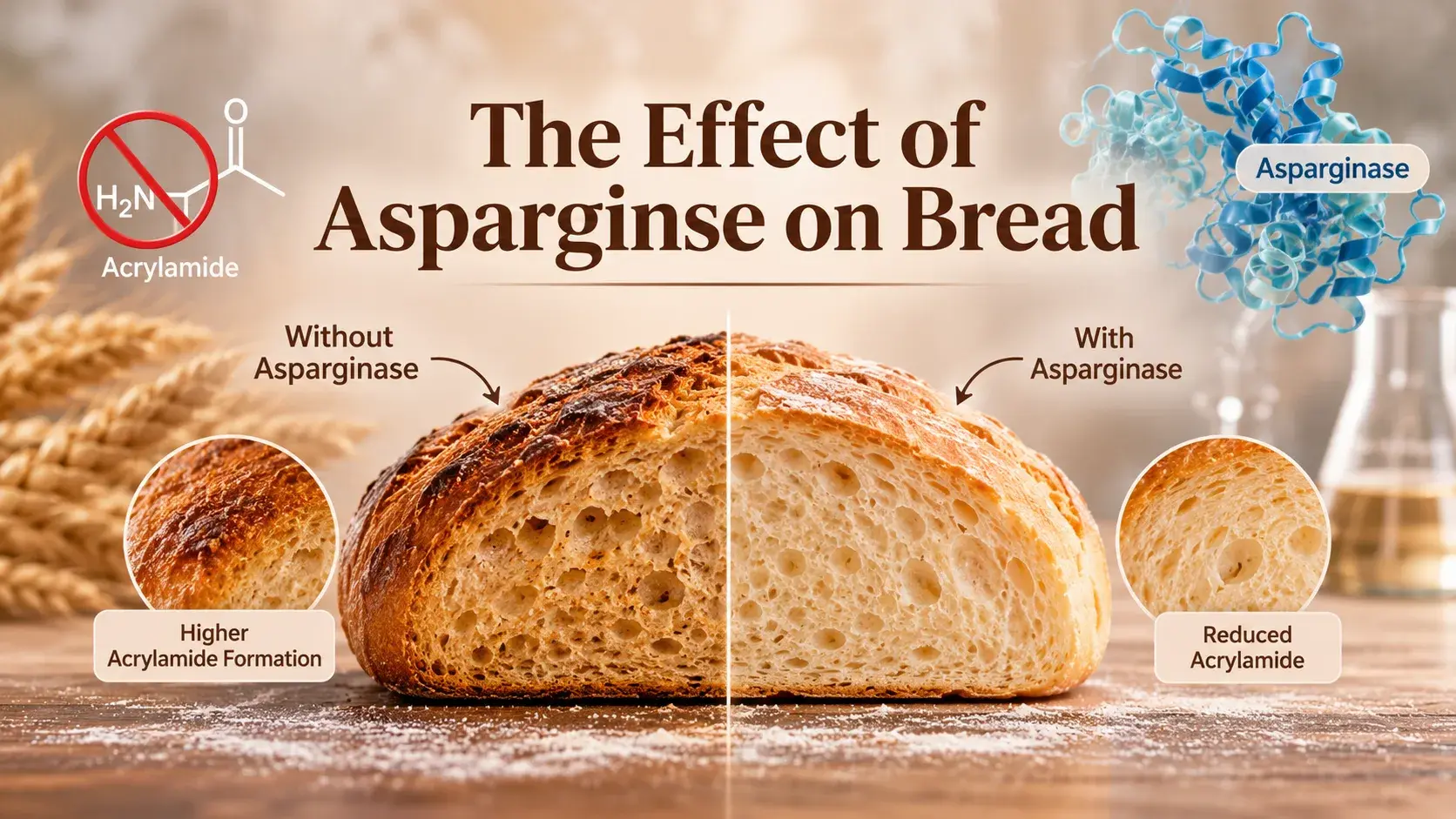
Effect of Asparaginase on Bread
The discovery of acrylamide in thermally processed, carbohydrate-rich foods transformed industrial cereal chemistry.

Is Dough a Liquid or a Solid? Physics of Herschel–Bulkley & Non-Newtonian Flow
When you look at a loaf of dough sitting on a baker’s bench, what do you see? A solid mass that holds its shape and can be molded by your hands?