Is Dough a Liquid or a Solid? Physics of Herschel–Bulkley & Non-Newtonian Flow
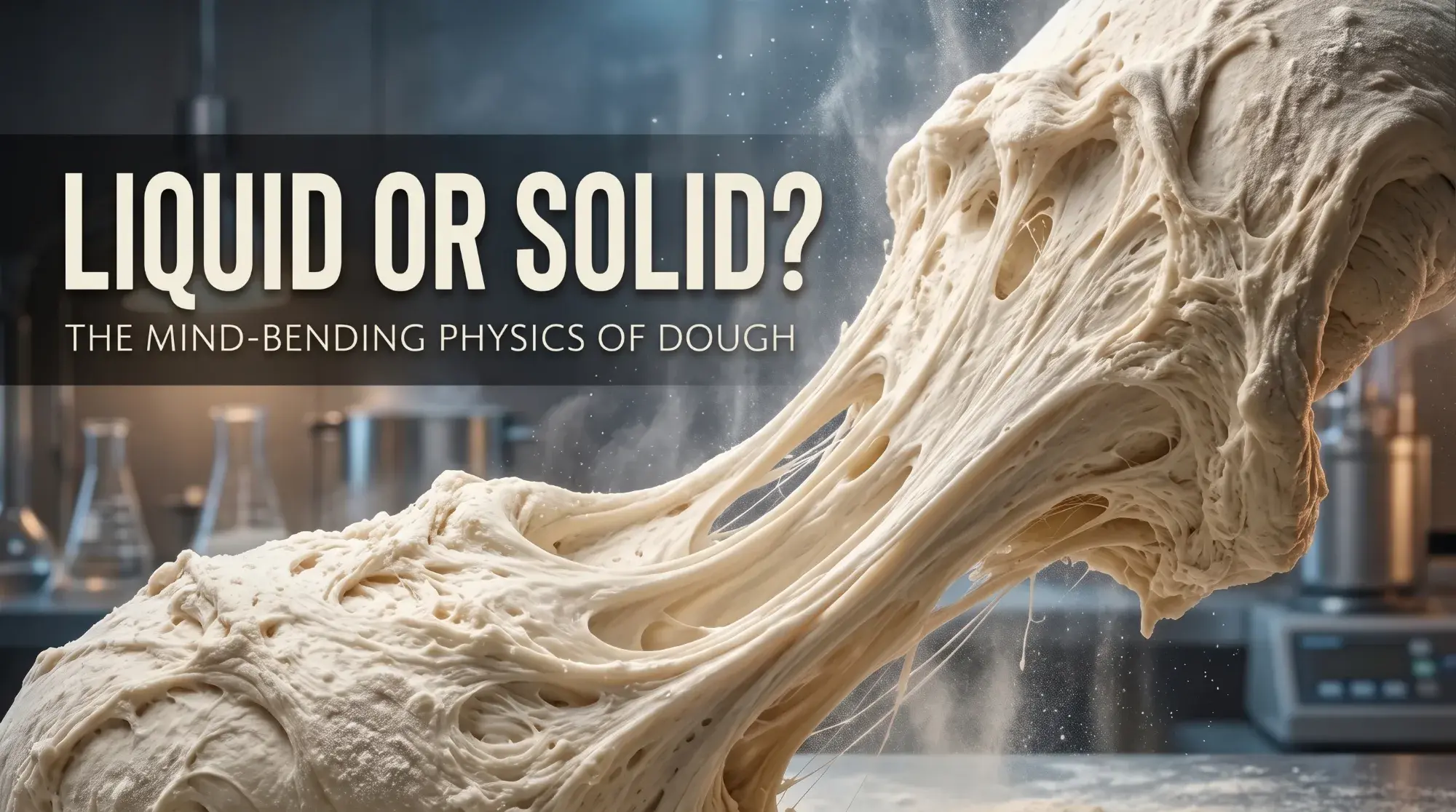
When you look at a loaf of dough sitting on a baker’s bench, what do you see? A solid mass that holds its shape and can be molded by your hands? But what happens when you leave that same dough in a hopper on an industrial production line for a few hours? It slowly spreads out, covers the bottom of the container, and flows like a liquid.
This is precisely where dough defies our everyday intuition: it is neither a pure solid nor a standard liquid. In baking science and food engineering, dough is a fascinating viscoelastic and plastic system that exhibits both elasticity (solid-like behavior) and viscosity (liquid-like behavior).
To understand this complex behavior, we need to step away from traditional Newtonian fluid mechanics and dive into rheology specifically, the Herschel–Bulkley flow model.
Flow Beyond Newton’s Limits: Non-Newtonian Dough
In Newtonian fluids like water or vegetable oil, viscosity remains constant regardless of how fast you stir or shear the liquid. Dough, however, is a complex polymeric network formed by an intertwined matrix of starch, water, and gluten proteins.
Because of this structure, dough acts as a non-Newtonian fluid. Its apparent viscosity changes dynamically depending on the applied shear stress () and deformation rate ().
How the Herschel–Bulkley Model Explains Dough Physics
The Herschel–Bulkley equation, which describes the relationship between shear stress () and shear rate () in plastic fluids, serves as the mathematical key to unlocking dough rheology:
Every single parameter in this equation dictates how flour performs on an extrusion line and how the final bread crumb structure develops:
1. Yield Stress (): The Threshold That Maintains Shape
Yield stress is what allows dough to behave like a solid when at rest. If the force applied to the dough is below this threshold (), it will not flow; instead, it stores the energy elastically like a spring.
- Industrial Impact: Yield stress is the reason shaped loaves (like baguettes or boules) hold their structure on a baking tray without slumping, while trapping fermentation gas bubbles inside the dough matrix prior to baking.
2. Shear-Thinning Behavior ()
Once the yield stress is exceeded, the dough begins to flow. However, because the flow behavior index is less than 1 (), the apparent viscosity decreases as the shear rate () increases.
- Molecular Mechanism: Under high shear rates—such as inside a high-speed mixer or an extrusion nozzle—tangled gluten polymer chains and starch granules align in the direction of flow. Temporary hydrogen bonds break, allowing the dough to move much more fluidly.
- Industrial Impact: Without shear-thinning, industrial extruders and volumetric dividers would require immense amounts of mechanical energy to pump dough through production lines.
3. Consistency Index ()
Parameters like water absorption capacity, dough temperature, and hydrocolloid additives directly influence the value, determining the overall internal resistance of the system.
Translating Rheology into Production Line Success
Measuring this delicate balance between solid and liquid behavior using dynamic oscillatory rheology (storage modulus and loss modulus ) is key to optimizing industrial bakery lines.
- Overly Elastic (Solid-Dominated) Dough: Extremely high yield stress; leads to dough tearing, snap-back during sheeting, and poor oven spring volume.
- Overly Viscous (Liquid-Dominated) Dough: Insufficient yield stress; results in dough spreading out after shaping, inability to retain fermentation gas, and structural collapse during baking.
Sources
- Reference: Hemphill T, Campos W, and Pilehvari A: "Yield-Power Law Model More Accurately Predicts Mud Rheology," Oil & Gas Journal 91, no. 34 (August 23, 1993): 45–50
Keep reading
All postsBaking Through the Lens of AI: Measuring Bread Quality with Image Processing
Can you guess the crispiness, softness, crumb structure, and even the aroma of a slice of bread just by looking at it?
Glass Transition Temperature in Bread and the Science of Staling
The aroma and texture of freshly baked bread—crispy on the outside, soft and pillowy on the inside is undoubtedly one of the most comforting culinary…
The UK Flour Fortification Mandate
Major updates are coming to the staple ingredients found in UK kitchens and grocery aisles.