Baking Through the Lens of AI: Measuring Bread Quality with Image Processing
Can you guess the crispiness, softness, crumb structure, and even the aroma of a slice of bread just by looking at it? Although it sounds impossible, advanced computer vision and artificial intelligence algorithms can now achieve this! Bread quality measurement, which traditionally relies on costly human panels taking days, is leaving its place to smart systems that deliver results in seconds.
The quality of a food product is determined by consumer expectations and industry standards. One of the most important dimensions of quality in the food industry is sensory evaluation. Today, this evaluation is carried out through trained sensory panels or consumer panels.
Although these panels provide the most reliable results closest to human experience, they have serious disadvantages:
- Time-Consuming: Organizing panels, conducting tests, and analyzing data takes a long time.
- High Cost: The employment of trained experts and logistical processes strain the budget
 How Was the Research Conducted?
Within the scope of the study, 54 different wheat bread varieties were collected from traditional bakeries and supermarkets across the Galicia region of Spain.
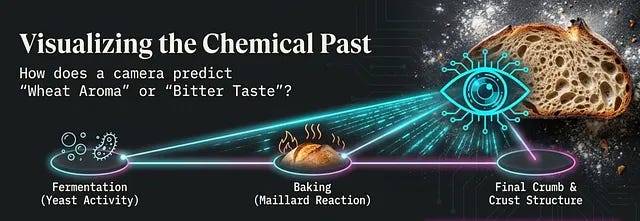
- Photography: High-resolution photographs of both the crust and crumb cross-sections were captured under standardized artificial lighting using everyday smartphone and tablet cameras.
- Expert Evaluation: The same bread samples were evaluated on a scale from 0 to 10 by a trained panel of 6 experts in dedicated tasting rooms adhering to ISO standards. A total of 24 distinct sensory attributes (crust color, crispiness, crumb structure, aroma, taste, etc.) were recorded.
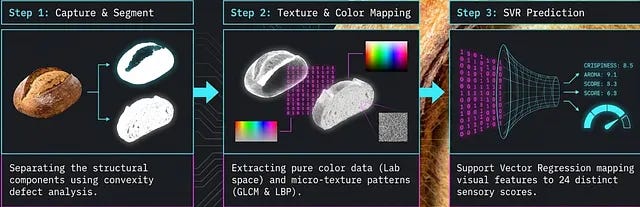
The developed AI system consists of three main stages:
- Segmentation: The algorithm automatically isolates the crust and crumb regions within the bread image.
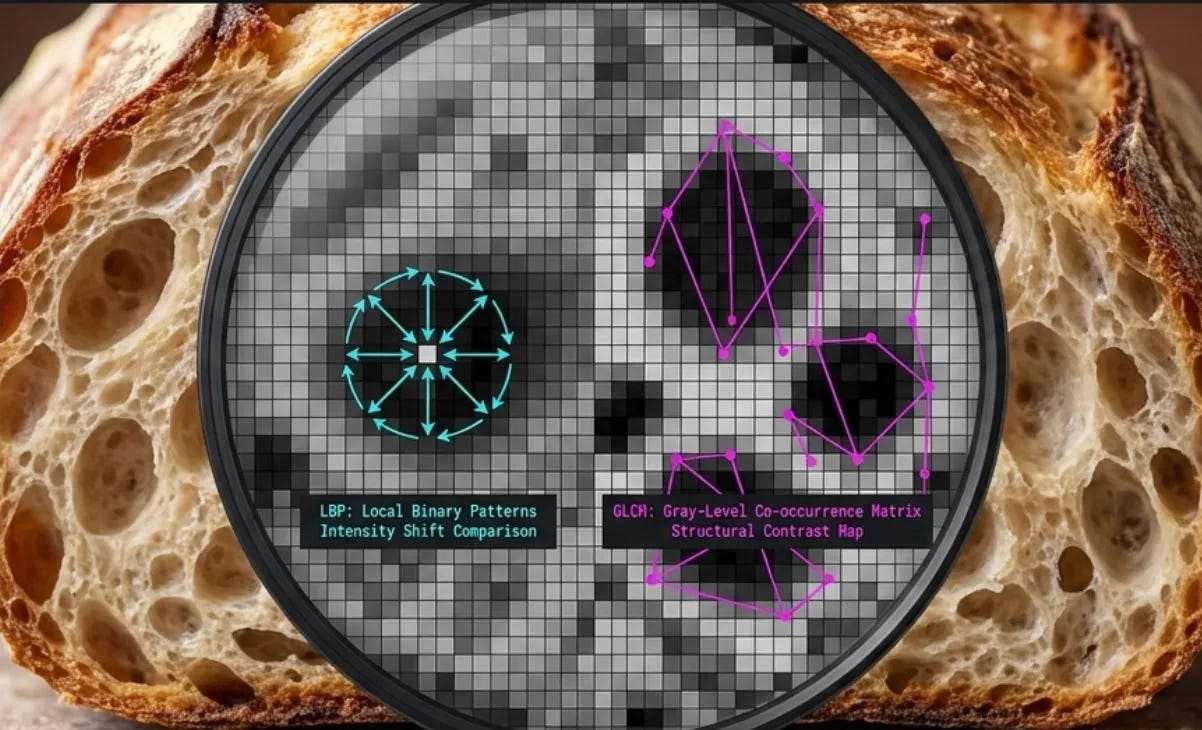
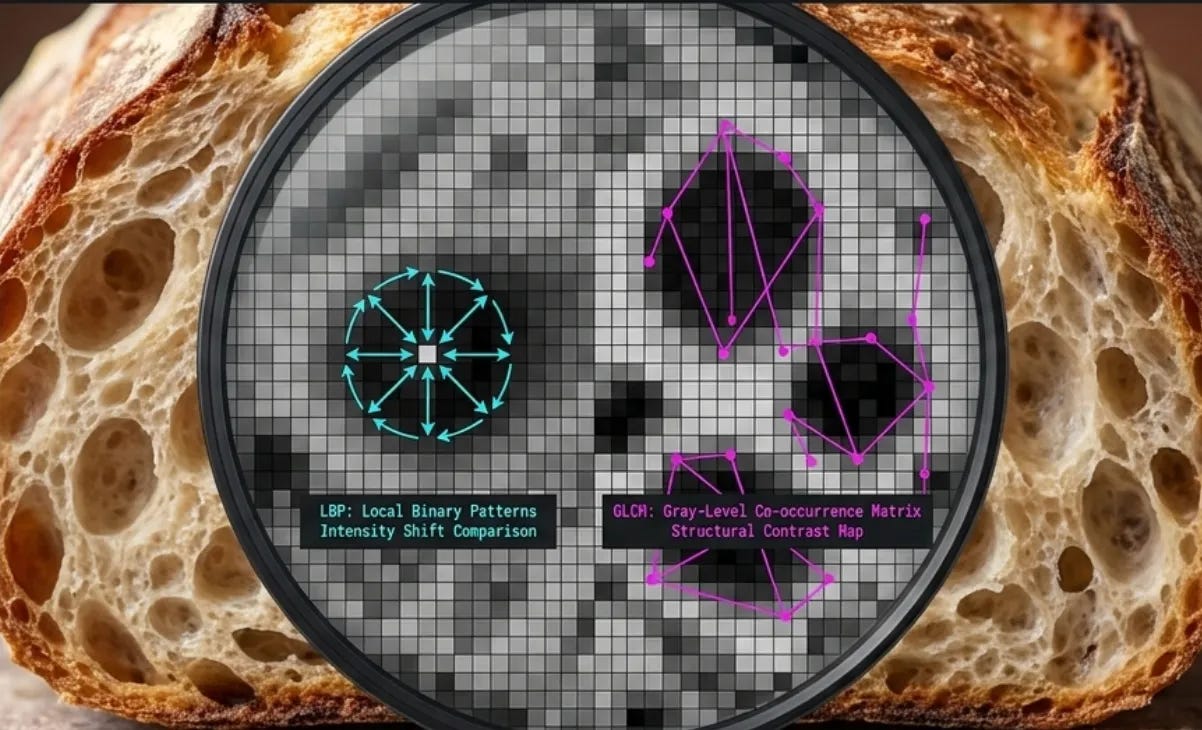
- Texture and Color Extraction: The bread’s color distribution (in RGB and Lab color spaces) and surface texture characteristics (utilizing GLCM and LBP algorithms) are transformed into numerical feature vectors.
- Predictive Modeling: The gathered visual data is fed into machine learning models — primarily Support Vector Regression (SVR) — to accurately predict the scores for all 24 sensory attributes.
What Do the Results Tell Us?
The rich feature vectors obtained were fed into Linear, Ridge, LASSO, Random Forest, and Support Vector Regression (SVR) models. Analyzing the results revealed that the SVR model demonstrated overwhelming superiority over other models in solving complex, non-linear relationships.
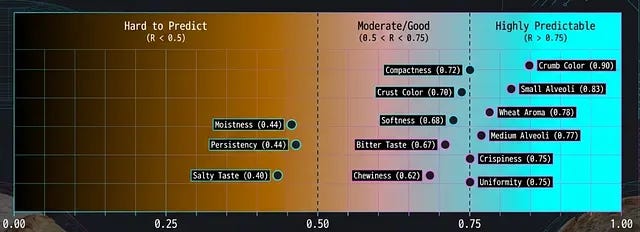
- High Reliability: For 7 out of the 24 analyzed attributes, the AI delivered near-perfect predictions. These include crumb color, quantity of small pores, wheat aroma, quantity of medium pores, quantity of large pores, pore distribution uniformity, and upper crust crispiness.
- Moderate/Good Reliability: 14 attributes were predicted with moderate to good accuracy.
- Challenging Areas: Low performance was observed in only 3 attributes: moisture, flavor persistence, and salty taste. Naturally, detecting attributes with no direct visual correlation — such as taste and aroma — solely through photographs proves more difficult.
Looking at the overall picture, for 22 out of the 24 sensory attributes, the Mean Absolute Error (MAE) remained below 1 point (representing a margin of error of less than 10% on a 10-point scale).
What Does This Mean for the Industry?
This study proves that the traces of chemical and physical processes in bread can be effectively decoded through its visual texture and color. Utilizing such artificial intelligence systems in the baking industry offers clear operational advantages:
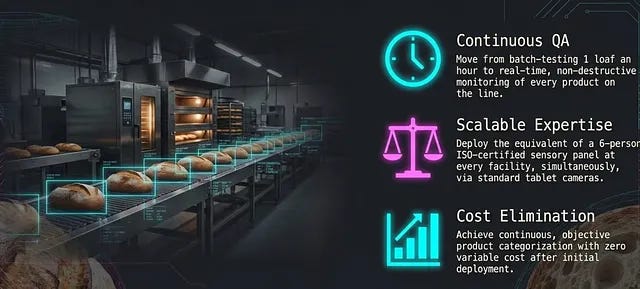
- Real-Time Quality Control: Enables instant monitoring directly on high-speed production lines, replacing days of lab evaluation.
- Objective Standardization: Eliminates human subjective bias and panel variability, ensuring consistent product standards.
- Cost Reduction: Drastically lowers sensory testing budgets, panel logistics, and training overhead.
- Inline Optimization: Provides rapid feedback loops to dynamically adjust process variables (fermentation time, dough hydration, and oven thermal profiles) before large-batch quality deviations occur.
Sources
Keep reading
All posts
Is Dough a Liquid or a Solid? Physics of Herschel–Bulkley & Non-Newtonian Flow
When you look at a loaf of dough sitting on a baker’s bench, what do you see? A solid mass that holds its shape and can be molded by your hands?
Glass Transition Temperature in Bread and the Science of Staling
The aroma and texture of freshly baked bread—crispy on the outside, soft and pillowy on the inside is undoubtedly one of the most comforting culinary…

The UK Flour Fortification Mandate
Major updates are coming to the staple ingredients found in UK kitchens and grocery aisles.