Effect of Asparaginase on Bread
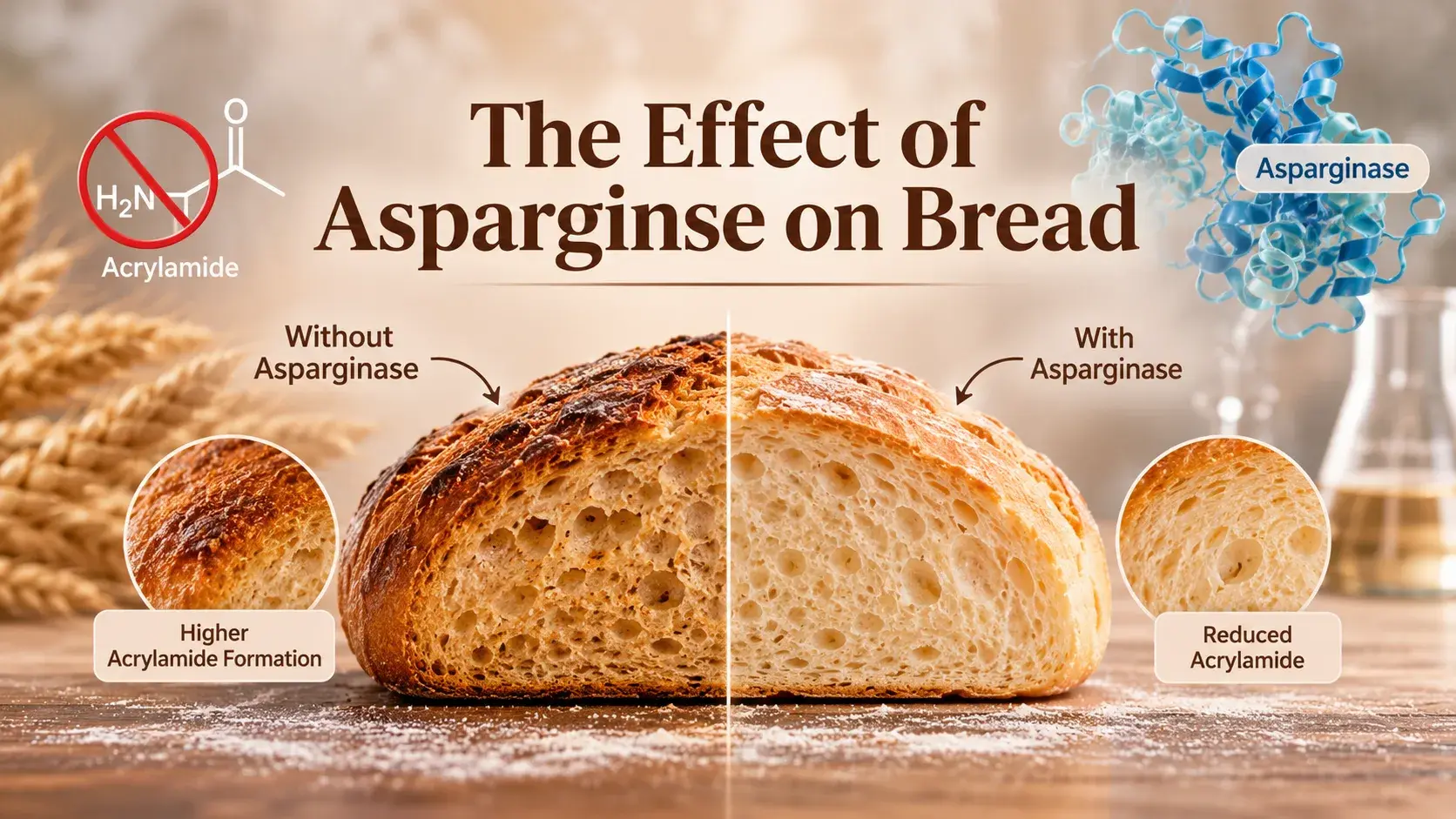
The Biochemical Blueprint: How Asparaginase Mitigates Acrylamide in Commercial Breadmaking
The discovery of acrylamide in thermally processed, carbohydrate-rich foods transformed industrial cereal chemistry. As a neurotoxin and Class 2A probable human carcinogen, acrylamide forms predominantly in the high-temperature outer crust of baked goods during the Maillard reaction. Commercial bakeries face the technical challenge of suppressing acrylamide formation without compromising the golden crust color, rich roasted aroma volatiles, or structural volume that consumers demand. Among the mitigation strategies developed over the past two decades, the application of the fungal enzyme asparaginase stands out as the most precise and effective solution. By selectively targeting and hydrolyzing free L-asparaginethe primary limiting precursor of acrylamide asparaginase interrupts toxicant synthesis before dough ever enters the oven, leaving essential flavor precursors, dough rheology, and crumb architecture completely intact.
1. The Acrylamide Challenge in Cereal Technology
Acrylamide () is a low-molecular-weight organic compound that generates spontaneously when carbohydrate-rich food matrices are exposed to temperatures exceeding (). In yeast-leavened breads, crispbreads, rolls, and biscuits, acrylamide synthesis is strictly confined to the dry outer crust, where surface temperatures reach to and local water activity drops below . The internal crumb, insulated by water evaporation and capped at a thermal plateau of to , remains entirely free of acrylamide.
The chemical mechanism driving acrylamide formation is a specific branch of the non-enzymatic Maillard browning cascade. At elevated temperatures, the unprotonated -amino group of free L-asparagine undergoes a nucleophilic condensation with the carbonyl group of reducing sugars, such as D-glucose, D-fructose, or maltose. This reaction forms an unstable Schiff base, which undergoes thermal decarboxylation and subsequent Strecker-type degradation to yield acrylamide along with various carbon fragments.
In yeast-leavened bakery formulations, the content of free L-asparagine in flour serves as the primary rate-limiting factor for final acrylamide levels:
| Cereal Matrix / Milling Fraction | Free L-Asparagine Content ( dry matter) | Typical Acrylamide Range in Final Baked Product () |
|---|---|---|
| Sifted Wheat Flour (Endosperm) | (White Bread Crust) | |
| Whole Grain Wheat Flour | (Whole Wheat Bread) | |
| Wheat Bran Fraction | (High-Fiber Breads) | |
| Wheat Germ Fraction | (Specialty Germ Loaves) | |
| Whole Grain Rye Flour | (Rye Crispbreads) |
Because free L-asparagine is concentrated in the aleurone layer, pericarp, and germ of the cereal grain, whole-grain, rye, and bran-enriched bakery formulations harbor significantly higher precursor loads than refined white flours. Agronomic factors also play a critical role: excessive nitrogen fertilization can increase free asparagine in wheat up to fourfold, while severe sulfur deficiency in soil causes a dramatic buildup of free asparagine up to 30-fold—due to disrupted protein synthesis kinetics.
2. The Enzymatic Pathway of Asparaginase
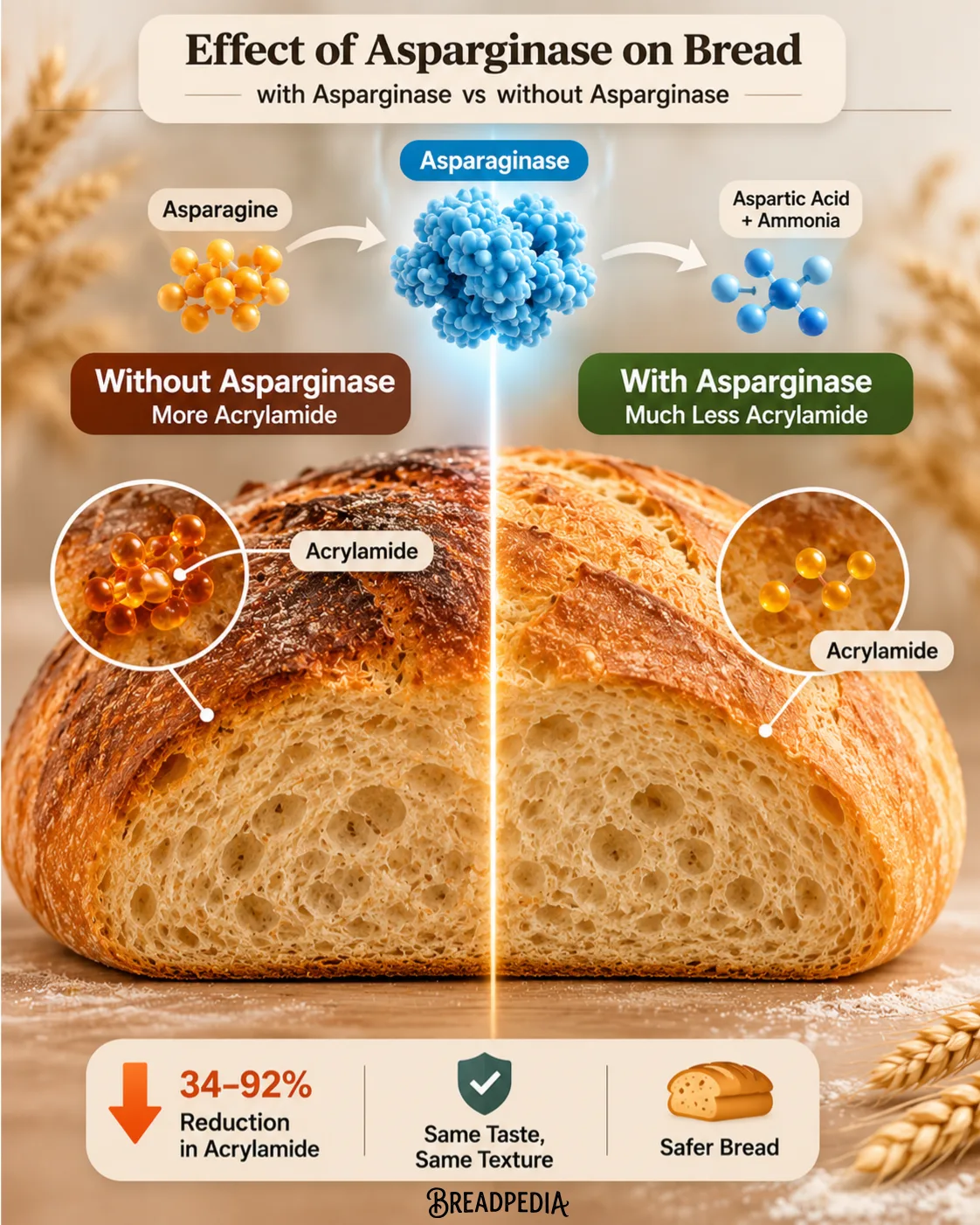
To mitigate acrylamide without altering product quality, industrial enzyme developers isolated targeted L-asparaginases (EC 3.5.1.1) derived from fungal strains such as Aspergillus niger and Aspergillus oryzae. Asparaginase operates as an amidohydrolase, catalyzing the cleavage of the amide bond in free L-asparagine to yield L-aspartic acid (aspartate) and free ammonia:
The enzymatic transformation alters the molecular structure of the amino acid substrate in two fundamental ways:
- Elimination of the Reactive Amide Core: The primary amide group that normally undergoes thermal decarboxylation to form the vinyl group of acrylamide is converted into a carboxylic acid group.
- Generation of Aspartate: L-aspartic acid remains a viable amino acid for general Maillard browning, but its degradation pathways do not yield acrylamide or other toxic byproducts.
The paramount advantage of asparaginase lies in its absolute substrate specificity. Unlike broad-spectrum proteases that cleave gluten peptide chains and weaken dough structure, asparaginase acts exclusively on free, unbound L-asparagine. Furthermore, detailed flavor-profiling research confirms that free L-asparagine plays a negligible role in generating key bread aroma compounds—such as 2-acetyl-1-pyrroline, pyrazines, and _2-methylpropanal_—which are synthesized primarily from other amino acids like L-proline, L-leucine, L-lysine, and L-ornithine. Consequently, removing L-asparagine eliminates the carcinogen precursor while preserving the authentic sensory identity of the bread.
3. Operational Kinetics and Industrial Efficacy
In commercial breadmaking operations, asparaginase is added directly into the mixer along with the dry ingredients and water. Because the enzyme requires liquid mobility to interact with its substrate, its activity begins as soon as the flour hydrates during mixing and continues throughout bulk fermentation, resting, and final proofing.
Industrial trials across white pan breads, hearth loaves, and rye crispbreads demonstrate that asparaginase treatment achieves a 34% to 92% reduction in final product acrylamide levels. The exact efficiency depends on three interconnected operational variables:
- Enzyme Dosage Rate: Standard commercial application rates range from 200 to 1,000 Asparaginase Units (U) per kilogram of dough (or approximately 25 to 100 ppm on flour weight). Increasing dosage accelerates precursor conversion up to a saturation plateau where enzyme mobility, rather than enzyme concentration, becomes the rate-limiting step.
- Dough Resting and Proofing Duration: Asparaginase requires sufficient contact time in the aqueous phase. In short-time or "no-time" commercial dough systems, a minimum resting time of 15 to 20 minutes is necessary to achieve >50% acrylamide reduction. Extended proofing durations (45 to 90 minutes) allow the enzyme to achieve 75% to 90% depletion of free L-asparagine.
- Moisture Content and Substrate Mobility: Higher dough absorption (higher water-to-flour ratio) increases the diffusion coefficient of both the enzyme and free L-asparagine within the viscoelastic gluten matrix. In low-moisture doughs, such as hard crackers or short-dough biscuits, higher enzyme dosages or extended hydration times are required to compensate for restricted molecular mobility.
During the baking phase, as the internal temperature of the dough piece rises above (), fungal asparaginase undergoes complete thermal denaturation. It functions strictly as a processing aid, leaving no active enzymatic residues in the finished loaf and requiring no E-number labeling on consumer packaging in many regulatory jurisdictions.
4. Preservation of Dough Rheology and Sensory Quality
A critical requirement for any industrial dough additive is that it must not destabilize dough machinability, gas retention, or finished bread quality. Extensive rheological evaluations using Farinograph, Extensograph, and Rheofermentometer testing confirm that asparaginase has zero adverse impact on gluten network structure or dough rheology:
- Mixing Behavior: Farinograph water absorption, dough development time (DDT), and mixing tolerance index (MTI) remain identical between control doughs and asparaginase-treated doughs.
- Extensibility and Elasticity: Unlike reducing agents (e.g., L-cysteine or sodium metabisulfite) that cleave disulfide bonds () and soften dough, asparaginase leaves the high-molecular-weight glutenin subunits untouched. Extensograph energy curves show no reduction in resistance to extension () or dough elasticity.
- Gas Production and Retention: Yeast (Saccharomyces cerevisiae) utilizes free amino acids as nitrogen sources, but asparaginase-mediated conversion of asparagine to aspartic acid does not impair yeast metabolic rates or gas production. Rheofermentometer curves confirm that maximum dough development height () and gas retention coefficients remain unchanged.
Colorimetric analysis using the color space proves that asparaginase-treated loaves develop identical golden-orange crust hues (, imperceptible to the human eye). Because free L-asparagine does not contribute significantly to red () or yellow () chromophore development compared to reducing sugars and other amino acids, asparaginase avoids the pale, unattractive crusts often caused by other mitigation strategies.
5. Comparative Evaluation: Asparaginase vs. Alternative Mitigation Strategies
To appreciate the effectiveness of asparaginase, it must be evaluated alongside alternative technological interventions for acrylamide reduction in bakery operations:
| Mitigation Strategy | Mechanism of Action | Acrylamide Reduction Potential | Impact on Processing and Bread Quality |
|---|---|---|---|
| Asparaginase Addition | Enzymatic conversion of L-asparagine to L-aspartate and ammonia | 34% -- 92% | Zero quality compromise. Preserves dough rheology, loaf volume, crust color, and authentic flavor. |
| Extended Yeast Fermentation | Yeast consumes free L-asparagine as a metabolic nitrogen source | 50% -- 85% | High operational cost. Long bulk fermentation weakens gluten structure, reduces throughput, and risks 3-MCPD formation. |
| Exogenous Glycine Fortification | Glycine competes with L-asparagine for reducing sugars | 30% -- 65% | Sensory alteration. Excessive glycine increases crust redness (), imparts off-flavors, and can retard yeast activity at high doses. |
| Organic Acid Addition (e.g., Citric Acid) | Lowers pH to protonate amino groups, inhibiting Schiff base formation | 40% -- 75% | Severe quality damage. Causes sour/acidic taste, suppresses yeast leavening, reduces volume, and produces pale crust. |
| Divalent Cation Addition () | Interferes with Schiff base stability during Maillard heating | 30% -- 50% | Toxicant trade-off. Inhibits acrylamide but accelerates formation of cytotoxic hydroxymethylfurfural (HMF). |
| Leavening Agent Replacement | Replacing with in biscuits/crackers | 60% -- 80% | Textural modification. Changes crumb porosity, spread ratio, and alkalinity in sweet goods. |
While extended yeast fermentation naturally depletes free L-asparagine by up to 85%, long fermentation times are economically unviable for high-speed industrial lines (such as the Chorleywood Bread Process) and can degrade gluten proteins, leading to loaf collapse. Organic acid additions severely impair leavening and crust color, while chemical cations introduce secondary toxicological risks such as elevated HMF levels. Asparaginase remains the only technology that achieves deep precursor removal with surgical precision and zero quality trade-offs.
6. Industrial Application Guidelines for Commercial Bakeries
For commercial flour millers and industrial baking plant managers seeking to integrate asparaginase into standard production lines, the following technical protocol optimizes mitigation efficiency:
- Precursor Assessment: Analyze incoming flour shipments for free L-asparagine levels. Whole-grain, high-extraction, and rye flours require higher initial enzyme dosing () compared to refined white flour ().
- Mixing Integration: Premix dry asparaginase powder with flour or dissolve liquid formulations in the metering water prior to dough mixing. Ensure uniform dispersion during the first low-speed mixing phase.
- Hydration and Proofing Optimization: Maintain standard dough hydration levels ( flour basis). Ensure a minimum floor time or intermediate proof of 15 to 20 minutes before final shaping to allow the enzyme to interact with hydrated substrate.
- Thermal Profile Management: Maintain standard baking thermal profiles (). Avoid over-baking or excessive crust desiccation, as acrylamide formation accelerates exponentially during the final minutes of low-moisture surface baking.
- Synergistic Formulations: Combine asparaginase with mild steam injection during initial oven spring. Steam condensation delays crust setting, maintains surface moisture, and works synergistically with asparaginase to achieve maximum acrylamide reduction.
By incorporating asparaginase into modern dough formulations, commercial bakeries successfully fulfill stringent food safety requirements while delivering the crisp crust, rich flavor, and soft crumb texture that define premium baked bread.
Sources
- Flour and Breads and Their Fortification in Health and Disease Prevention (Victor R. Preedy, Arwa Mustafa et al.)
- Baking Problems Solved (2nd Edition) (Stanley P. Cauvain & Linda S. Young)
- Bakery Products Science and Technology (2014 Edition) (Y. H. Hui, W. Zhou, Emmanuel Purlis et al.)
- de Boer, L., Meermans, C. E. M., & Meima, R. B. (2005) — "Reduction of acrylamide formation in bakery products by application of Aspergillus niger asparaginase", Woodhead Publishing
- Hendriksen, H. V. et al. (2009) — "Evaluating the potential for enzymatic acrylamide mitigation in a range of food products using an asparaginase from Aspergillus oryzae", J. Agric. Food Chem.
- Amrein, T. M. et al. (2004, 2007) — "Acrylamide in bakery products: Critical factors for formation and possible ways for reduction", J. Agric. Food Chem. & Food Addit. Contam.
- Zyzak, D. V. et al. (2003) — "Acrylamide formation mechanism in heated foods", J. Agric. Food Chem
- Surdyk, N., Rosén, J., Andersson, R., & Åman, P. (2004) — "Effects of asparagine, fructose, and baking conditions on acrylamide content in yeast-leavened wheat bread", J. Agric. Food Chem.
- Mottram, D. S., Wedzicha, B. L., & Dodson, A. T. (2002) — "Acrylamide is formed in the Maillard reaction", Nature
Keep reading
All postsEffect of Steam on Bread
Baking is fundamentally a thermodynamic phase-change process in which a viscoelastic dough foam is converted into a stable, porous crumb structure…
The Effect of Salt on Bread
Bread making appears deceptively simple on the surface, relying on just four fundamental ingredients: flour, water, yeast, and salt.
Perfect Crust, Zero Flaking: Thermo-Mechanical Causes and Remediation of Crust Flaking in Bread
# In the modern baking industry, par-baked frozen bread technology is one of the most critical industrial innovations.