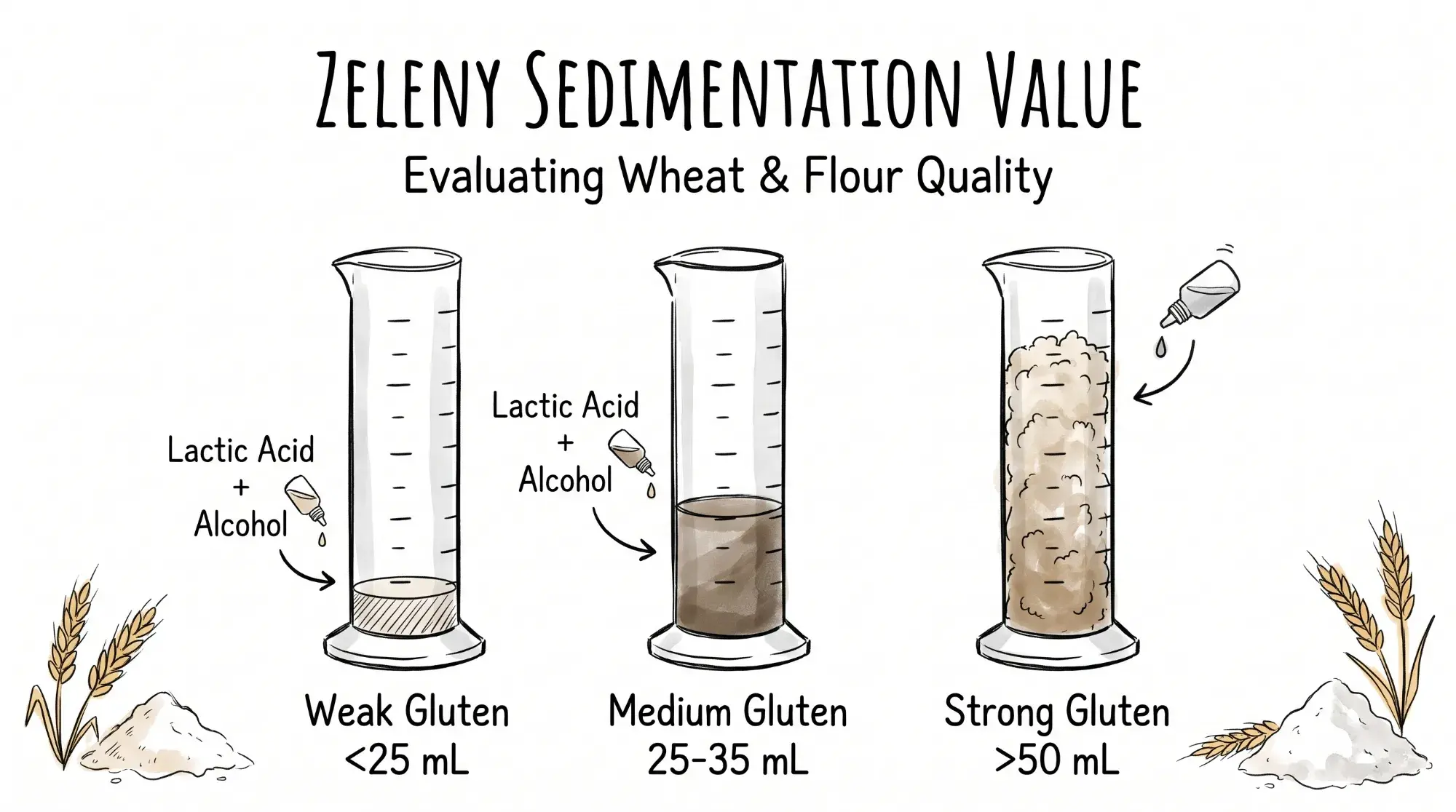
Zeleny Sedimentation Value
Definition
The Zeleny Sedimentation Value is a standardized, empirical physicochemical laboratory metric used to evaluate the technological quality, gluten strength, and swelling capacity of wheat flour proteins (specifically the glutenin fraction). It measures the volume of sediment (expressed in milliliters, mL) produced when a fine flour sample or ground wheat meal is suspended in a dilute lactic acid and isopropyl alcohol (or SDS) solution under controlled shaking and settling conditions
Physicochemical Mechanism & Working Principle
- Hydration and Acid Swelling: When wheat flour is mixed into a lactic acid-isopropyl alcohol reagent, hydrated gluten proteins—predominantly High Molecular Weight Glutenin Subunits (HMW-GS)—absorb the acidic solvent and undergo extensive swelling
- Sedimentation Kinetics:
- Strong Gluten: High-quality, un-degraded glutenins with a high degree of intermolecular disulfide cross-linking form large, highly hydrated protein aggregates. These swollen flocculates settle slowly, resulting in a large sediment volume
- Weak Gluten: Low-quality or degraded gluten proteins absorb less solvent, swell weakly, and rapidly collapse to the bottom of the cylinder, yielding a low sediment volume
- Separation from Non-Protein Components: Starch granules and soluble endosperm components settle quickly or dissolve, allowing the boundary of the suspended swollen gluten matrix to be clearly read on the graduated cylinder
Quality Classification & Benchmark Ranges
The Zeleny sedimentation value directly classifies wheat cultivars into technological strength categories:
- Low Sedimentation (): Weak wheat flour. Indicates poor gluten elasticity and low swelling power; suitable primarily for biscuits, pastries, or wafers.
- Medium Sedimentation (): Medium baking quality. Typical for general-purpose commercial flour streams; produces loaves with average volume and crumb density.
- High Sedimentation (): Strong bread-making flour. Reflects robust protein quality, excellent dough stability, and high volume potential.
- Very High Sedimentation (): Extra-strong wheat flour. Characterized by superior gluten macropolymer (GMP) content; ideal for industrial high-stress dough mixing, long fermentation regimes, or for strengthening weaker flour streams.
Correlations with Rheology & End-Use Quality
- Flour Protein & Gluten Content: The Zeleny value exhibits strong positive correlations with crude protein percentage () and wet gluten yield.
- Alveograph & Farinograph Indicators: Higher Zeleny values correlate with increased Alveograph deformation energy (), dough tenacity (), Farinograph stability, and Farinograph Quality Number (FQN).
- Loaf Volume () & Crumb Hardness (): The Zeleny index is one of the single best predictive variables for bread volume (). Higher sedimentation volumes consistently yield larger loaf volumes, thinner cell walls, and reduced crumb hardness.
Factors Degrading the Zeleny Value
- Proteolytic Degradation: Enzymatic cleavage of peptide bonds by endogenous proteases or wheat bug (Eurygaster) infestation breaks down high-molecular-weight glutenin chains, dramatically reducing swelling capacity and Zeleny values.
- Heat Damage: Overheating wheat during post-harvest drying denatures glutenins prematurely, eliminating their acid-swelling capability and collapsing the sedimentation height.