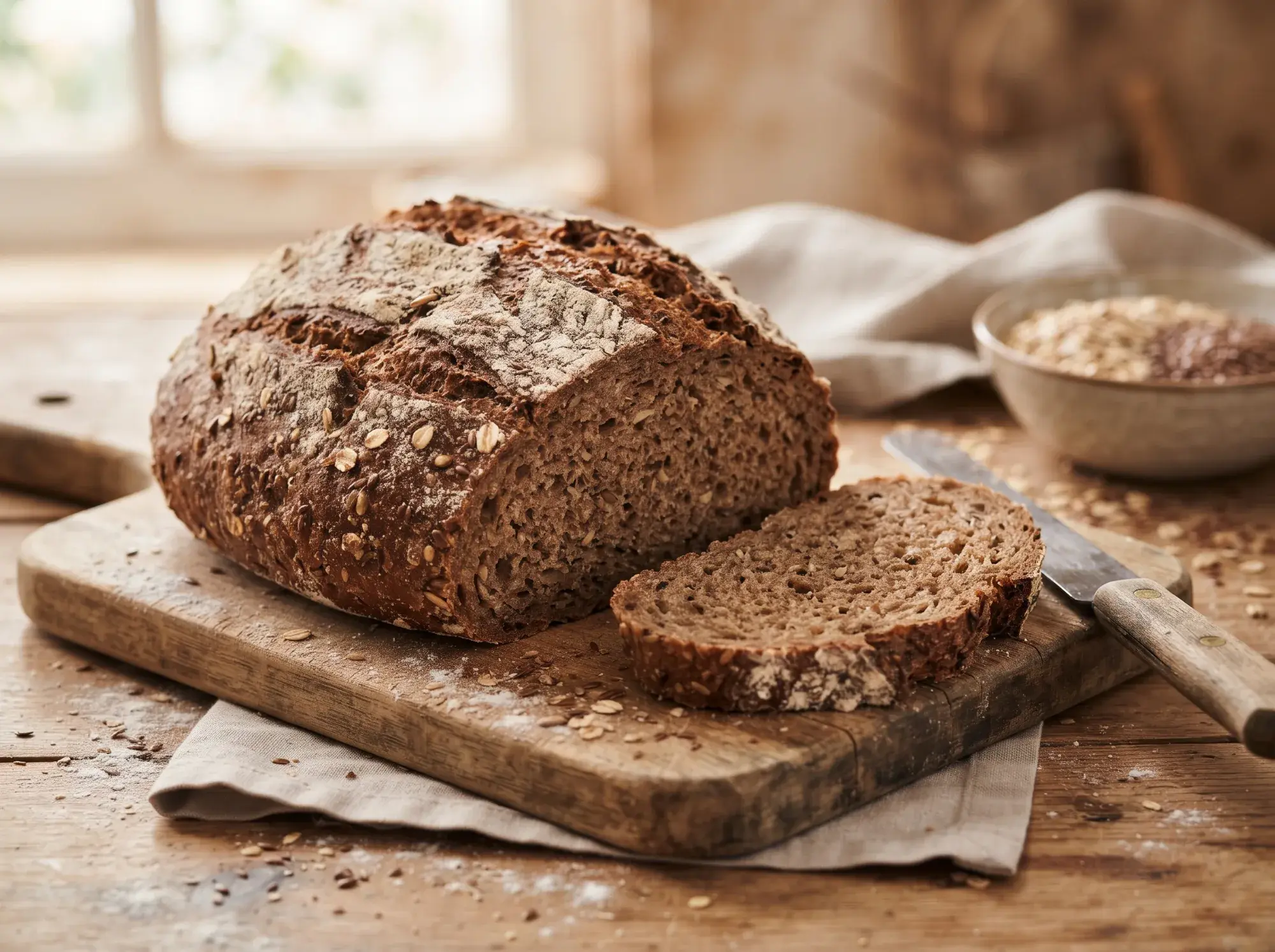
Whole Wheat Bread
Also known as Wholemeal Bread
Whole wheat bread (or wholemeal bread) is produced using flour that retains 100% of the anatomical components of the wheat grain the endosperm, germ, and bran in the exact natural proportions present in the intact kernel. While offering substantial nutritional advantages over refined white bread, the inclusion of bran and germ presents major technological challenges to dough rheology, gas retention, and finished loaf volume.
Chemical Composition & Nutritional Profile
- Dietary Fiber Content: Whole wheat bread typically contains 8% to 9% total dietary fiber (TDF)—compared to only ~2% in white bread. The fiber fraction consists predominantly of insoluble dietary fiber (cellulose, lignin, and water-insoluble arabinoxylans) alongside soluble arabinoxylans and \(\beta\)-glucans.
- Bioactive Compounds: The pericarp, aleurone, and germ layers contribute high concentrations of phenolic acids (mainly bound ferulic acid), alkylresorcinols, tocols (vitamin E), and carotenoids. Whole wheat bread delivers 150–165 mg / 100 g of total phenolics compared to 79–103 mg / 100 g in refined white bread, providing significantly higher in vitro antioxidant activity.
- Micronutrients & Anti-Nutrients: Whole wheat flour is naturally rich in essential minerals (iron, zinc, magnesium, potassium) and B-group vitamins. However, it also contains significant amounts of phytic acid (myo-inositol 1,6-hexakisphosphate), an anti-nutritional compound concentrated in the aleurone layer that chelates divalent cations ,, and lowers their intestinal bioavailability.
Physicochemical & Rheological Impact of Bran
The inclusion of bran impairs bread quality reducing specific loaf volume by 15% to 25% and producing a denser, firmer crumb—through three primary biochemical mechanisms:
- Gluten Dilution: Replacing endosperm flour with bran physically dilutes the concentration of glutenin and gliadin proteins per unit mass, reducing the density of the viscoelastic protein matrix capable of trapping fermentation gases ()
- Physical Matrix Disruption: Coarse bran particles and sharp pericarp fragments (including microscopic epicarp hairs) act as physical puncture points that cut through gluten membranes, causing gas cell wall instability and premature bubble coalescence during proofing and early baking.
- Competitive Water Hydration: The abundant hydrophilic hydroxyl groups on bran pentosans (arabinoxylans) rapidly bind free water. This severe competition for water partially dehydrates gluten proteins, impeding full protein hydration and network formation during mixing.
Flour Granulation & Processing Kinetics
- Particle Size Dynamics: Finely ground whole wheat flour performs more like refined white flour because its smaller particle size allows more gluten protein to hydrate and form a continuous network. Fine whole wheat flour achieves adequate loaf volume with only 3% added vital wheat gluten, whereas medium or coarse whole wheat meals require approximately 5% vital wheat gluten due to protein being physically trapped within coarse kernel fragments.
- Viscosity Shift During Processing: Fiber hydration occurs at a slower rate than endosperm starch hydration. Consequently, whole wheat doughs leave the mixer feeling soft and slightly tacky, but gradually absorb water during floor time, becoming "tight" and highly viscous prior to final moulding. If unadjusted, this sudden increase in dough viscosity causes mechanical damage at the moulder, resulting in dark crumb streaks and firm patches.
Technological Remediation & Bioprocessing
To overcome volume loss and structural collapse, commercial whole wheat bread manufacturing employs targeted formulation and bioprocessing strategies:
- Vital Wheat Gluten Supplementation: Adding 0.4 lb of vital wheat gluten per pound of high-fiber ingredient (or 3% to 5% flour basis) compensates for gluten dilution, restoring gas retention and target loaf volume.
- Sourdough & Phytase Fermentation: Sourdough fermentation with heterofermentative lactic acid bacteria (Lactobacillus sanfranciscensis) lowers dough pH to 3.8–4.5. This acidic environment activates endogenous cereal phytases and microbial enzymes, degrading phytic acid by up to 71% (compared to ~52% with yeast alone) and dramatically improving mineral solubility and absorption.
- Enzymatic Modification (Xylanases): Adding exogenous xylanases (hemicellulases) hydrolyzes water-insoluble arabinoxylans into soluble pentosans. This solubilization reduces water entrapment, enhances dough extensibility, stabilizes gas cell walls, and increases specific loaf volume.